
Humanoids

Humanoid Robots
Humanoid robots need to continuously interpret multiple streams of visual information while reacting to people, objects, and changing environments in real time. This creates demanding requirements for image quality, processing latency, AI compute, power consumption, and memory architecture.
A humanoid’s cameras continuously generate large amounts of visual information. Processing that information efficiently requires much more than AI compute alone. Before an AI model can interpret a scene, raw camera data must first be processed and optimized for machine perception.
Enabling Key Capabilities
Humanoid Perception Software
Humanoid robots that share spaces with people need to understand not just their surroundings, but the humans within them. Visual perception lets a robot recognize faces, read body language, follow gestures, and notice where someone is looking or moving, while AI-based analysis turns those cues into an understanding of intent, emotion, and social context. Current Edge AI vision architectures support this kind of real-time interaction, enabling robots to detect people, interpret their actions, and respond naturally and safely in the moment.
Object and Human Detection
Humanoids may operate in spaces shared with people. Cameras and perception algorithms can provide the visual information required by downstream systems to detect people and objects.
Edge perception architectures already combine HDR image processing with NPU and DSP compute for tasks including object and pedestrian detection.
Multi-Camera Perception
A humanoid may require different camera perspectives to perceive its surroundings.
Multi-camera vision architectures can process several sensor streams simultaneously while maintaining low processing latency. Current vision processors support multi-camera inputs, and some architectures can handle up to four cameras and eight independent image pipelines simultaneously.
3D and 360-Degree Vision
3D and 360-degree vision can provide richer spatial information to robotic perception systems. Smart-camera vision architectures specifically identify 3D and 360-degree vision systems among their supported applications.
Smart Cameras
Instead of sending every raw camera stream directly to a central processor, smart-camera architectures can perform image processing and AI workloads closer to the sensor.
This distributes perception workloads across the robotic system and can offload central compute resources for other system tasks.
Radar Sensing
Radar sensing can complement vision by providing real-time object detection, distance, and velocity measurements around the robots. The additional sensing layer can support proximity awareness and collision avoidance, particularly in environments where cameras may be challenged by darkness, low light, dust, fog, or other particles.
Why Advanced Vision Processing Matters for Humanoids
High-resolution cameras continuously generate large amounts of visual data.
When several cameras operate simultaneously, the robot must manage increasing:

Processing requirements
Memory requirements

Data bandwidth

Power consumption

System complexity
Dedicated vision processing can handle essential image-processing functions before the visual information reaches the robot’s higher-level AI and computing systems.
A distributed perception architecture can look like:
Cameras → ISP → Geometric Processing → Edge AI → Central Compute
Proprietary ISP Technology
The Image Signal Processor (ISP) is a critical element between the image sensor and the AI perception layer.
Advanced ISP architectures can support:

Multi-camera inputs

High-dynamic-range imaging

Low-light image processing

Color processing

High-resolution sensors

Multiple color-filter arrays

Low-latency processing

Machine-vision optimized outputs
Sense. Process. Understand. Interact.

Sense
Capture the environment through multiple image sensors

Process
Transform raw sensor data into optimized visual information.
Understand
Analyze the resulting information through computer vision and AI.
Interact
Provide perception information to the broader robotic system.
Geometric Processing and Distortion Correction
Humanoid robots can use wide-field-of-view cameras to increase awareness of their surroundings.
However, wide-angle optical systems can introduce geometric distortion, making dedicated geometric processing an important part of the visual perception pipeline.
Key Functions

Lens distortion correction

Image warping

Electronic pan, tilt, and zoom

Digital camera calibration

Multi-camera geometric processing
Edge AI for Real-Time Perception
Image processing prepares visual information. Edge AI can help interpret it.
Heterogeneous compute architectures allow different workloads to run on specialized processing engines.
Neural Processing
Dedicated NPUs accelerate neural-network and AI inference workloads.
Digital Signal Processing
DSP resources handle classical signal-processing tasks.
Application Processing
General-purpose CPU resources support operating systems, existing code bases, and application-level workloads.
Image Signal Processing
Dedicated ISP hardware prepares multi-camera visual information for downstream perception.
Geometric Processing
Dedicated hardware handles geometric image transformations alongside the ISP pipeline.
Video Encoding
Integrated hardware encoding can compress camera information for streaming and other video-processing requirements.
Why it matters for robotics
Camera → ISP → Geometric Processing → AI Compute → Perception
This architecture allows camera information to be processed before reaching downstream perception workloads.
Products
iND881

Edge AI Video Processor SoC
iND880
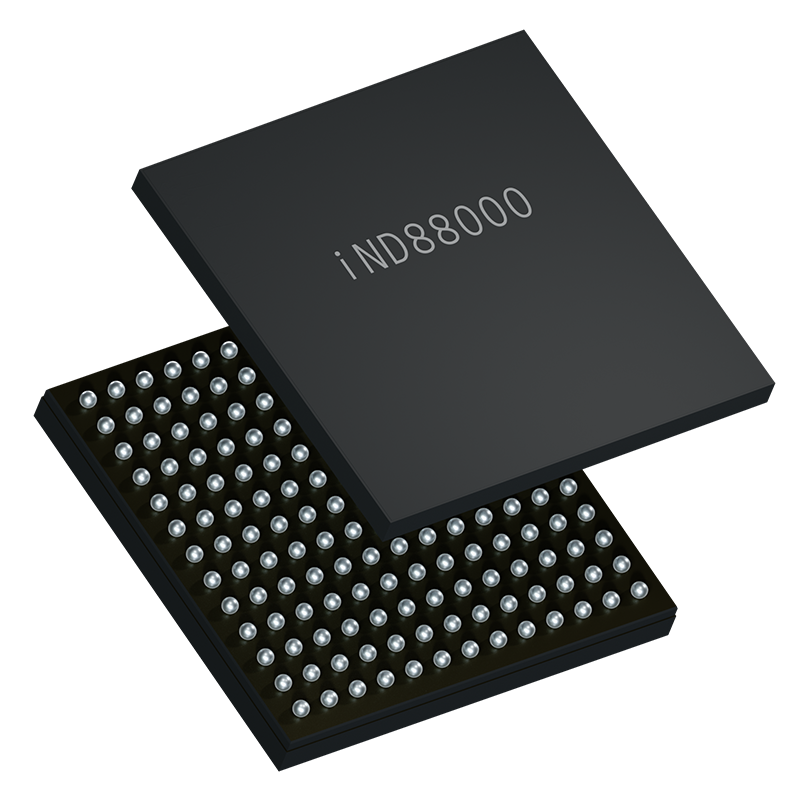
Camera Video Processor
Humanoid Perception Software

Perception Software
Resources
indie Launches Edge AI SoC to Power Smarter Perception Systems for Automotive and Humanoids
indie (Nasdaq: INDI), an automotive solutions innovator, announced the release of iND881, its next-generation edge artificial intelligence (AI) system-on-chip (SoC), incorporating an AI compute engine to power smart cameras for automotive and robotic applications.
indie Semiconductor Introduces Class-leading Computer Vision Processor Family
Enables simultaneous human viewing and ADAS sensing capability in a single SoC platform. Delivers superior low-light and high dynamic range sensing for improved perception performance
Demonstrating Real‑World Perception Solutions and More at AutoSens and InCabin USA
AutoSens and InCabin USA continue to be a key event for automotive suppliers and OEMs, where the concentration of ADAS, in-cabin sensing, experience, and automotive innovation takes center stage