
Quantum Key Distribution (QKD)
Future-Proof Security for the Quantum Era
As quantum computing advances, traditional encryption methods face increasing risks. Quantum Key Distribution (QKD) provides a fundamentally different approach to cybersecurity by leveraging the laws of quantum mechanics to securely exchange encryption keys and detect any attempt at interception.
indie’s photonic technologies enable the next generation of QKD systems, providing the laser sources, optical filtering technologies, and photonic integration capabilities required to build scalable, reliable, and high-performance quantum-secure communication networks.

Why Quantum Key Distribution?
Unlike conventional public-key cryptography, whose security depends on mathematical complexity, QKD derives its security from the fundamental principles of quantum physics. Any attempt to observe or intercept quantum states creates detectable disturbances, allowing communication partners to identify compromised transmissions.
Key Benefits

Information-theoretic security based on quantum mechanics

Protection against future quantum computer threats

Detection of eavesdropping attempts in real time

Compatibility with existing optical communication infrastructure

Secure key generation for government, financial, healthcare, defense, and critical infrastructure applications
QKD Technologies
Discrete-Variable QKD (DV-QKD)
DV-QKD uses individual quantum states encoded in photons and detected by single-photon receivers. Industry-standard protocols such as BB84, Decoy-State BB84, Coherent One-Way (COW), and DPS-QKD rely on photon polarization or phase states to generate secure cryptographic keys.
Advantages

Proven security framework

Commercially deployed implementations

Multiple mature protocol options
Typical Requirements

Stable narrow-linewidth laser sources

Accurate phase and polarization control

High-performance photonic components and filtering technologies
Continuous-Variable QKD (CV-QKD)
DV-QKD uses individual quantum states encoded in photons and detected by single-photon receivers. Industry-standard protocols such as BB84, Decoy-State BB84, Coherent One-Way (COW), and DPS-QKD rely on photon polarization or phase states to generate secure cryptographic keys.
Advantages
Proven security framework
Commercially deployed implementations
Multiple mature protocol options
indie’s Photonic Building Blocks for QKD
Successful QKD deployment requires exceptionally stable optical components capable of maintaining quantum coherence while minimizing noise and signal degradation.
Ultra-Low Noise Lasers
indie’s narrow-linewidth laser technology provides the frequency stability and low phase noise required for:
- CV-QKD transmitters and receivers
- Coherent detection systems
- Frequency locking architectures
- Long-distance quantum communication links
Optical Filtering Solutions
indie’s advanced Fiber Bragg Grating (FBG) technologies support:
- Spectral filtering
- Channel isolation
- Noise suppression
- Wavelength stabilization
These capabilities help maintain signal integrity and improve system performance in demanding quantum environments.
Photonic Integration and Packaging
indie enables the integration of lasers, photonic integrated circuits (PICs),
and optical subsystems into compact and scalable platforms for next-generation quantum communication systems.
Why Choose indie?
indie combines decades of expertise in photonics with advanced laser, filtering, and integration technologies specifically suited for quantum communications.
What Are Fiber Bragg Gratings?
Fiber Bragg Gratings (FBGs) are periodic variations in the refractive index along the core of an optical fiber, creating a mirror-like effect that reflects specific wavelengths while transmitting others. This modulation of the refractive index allows for precise control over light, influencing both the spectral and temporal properties of the signal. The specific pattern of the index changes determines how the FBG interacts with light, enabling it to manipulate certain wavelengths at controlled positions within the fiber. This creates differences in optical paths that allow for temporal control of the light signal.

Key Features
Durability and Stability
FBGs are made from optical fiber, which is resistant to harsh environmental conditions, such as extreme temperatures, corrosion, and electromagnetic interference. This durability ensures long-term stability and performance across many applications.
Compact and Lightweight
FBGs are integrated within optical fibers, making them compact, lightweight, and easy to deploy in space-constrained environments. This is beneficial in industries like aerospace, telecommunications, and medical devices.
High Precision and Accuracy
FBGs can be precisely tailored to specific wavelengths and are capable of highly accurate measurements, making them indispensable in applications that require fine control over light, such as in laser systems and high-precision sensing.
Related Products
Visible DFB Laser Diode
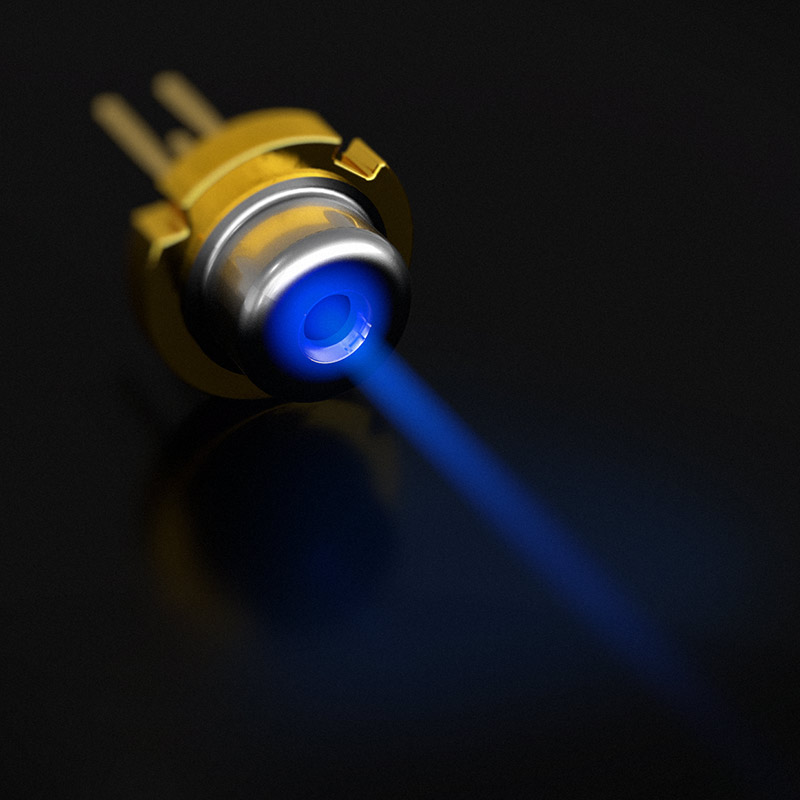
Narrow-linewidth laser with a high side-mode suppression ratio, minimizing unwanted modes for superior signal clarity.
C-Band DFB Laser Diode

Narrow-linewidth and flat frequency modulation, enabling cost-efficient coherent sensing systems without expensive lasers or modulators.
Ultra-Narrow DFB Laser Module (LXM)

Narrow linewidth, rugged, compact and highly stable laser module for challenging applications.
Fixed Dispersion Compensators (DCML)

Ultra-low loss, minimal latency, and robust passive design to prevent nonlinear impairments.
Tunable Optical Filters (TFN)

Compact and reliable thermally controlled platform for narrowband and ultra-narrowband tunable optical filters with unprecedented stability and resolution.
Fixed Optical Filters (OF)

High-performance Fiber Brag Grating (FBG) optical filters designed to the strictest specifications and tolerances.
Resources
Photonic Building Blocks for QKD with indie Technology
Learn how indie leverages ultra-low-noise lasers, optical filters, and dispersion compensation technologies to enhance the performance, security, and reach of Quantum Key Distribution (QKD) systems.
Quantum Key Distribution in Optical Communications
Learn how indie leverages ultra-low-noise lasers, optical filters, and dispersion compensation technologies to enhance the performance, security, and reach of Quantum Key Distribution (QKD) systems.
Discrete-Variable Quantum Key Distribution
Learn how indie enhances discrete-variable Quantum Key Distribution (DV-QKD) systems with advanced dispersion compensation, optical filtering, and ultra-low-noise laser technologies for secure quantum communications.