
Autonomous Vehicles

Autonomous vehicles
Autonomous vehicles must continuously perceive and interpret a complex, dynamic environment. From identifying road users and lane boundaries to measuring distance, detecting obstacles, and understanding vehicle surroundings, automated mobility depends on reliable sensing and real-time processing.
No single sensing technology addresses every operating condition equally well. Modern perception architectures therefore combine cameras, radar, LiDAR, ultrasonic sensing, and increasingly AI-based perception to build a more complete understanding of the environment. Sensor fusion brings these complementary sources together to support enhanced perception and decision-making.
Enabling Key Capabilities
Exterior Perception
Autonomous vehicles require continuous awareness of their surroundings. Cameras, radar, LiDAR, and ultrasonic sensors provide complementary information about objects, road users, distances, motion, and the surrounding environment.
Object Detection and Recognition
Vision systems provide rich visual information that can support object recognition and environmental interpretation. High-performance image processing prepares camera information for computer-vision and AI perception workloads.
Distance and Velocity Measurement
Radar provides object detection and relative-speed information across a range of weather conditions, while LiDAR provides precise ranging and detailed spatial information. Coherent LiDAR can additionally measure range, velocity, and reflectivity.
Automated Driving Functions
The sensing modalities used in automated driving support functions including emergency braking, adaptive cruise control, lane keeping, automated parking, blind-spot management, cross-traffic alerts, and highway or urban driving assistance.
In-Cabin Occupant Monitoring
Autonomous mobility also requires information from inside the vehicle. Interior cameras and sensing technologies can support driver and occupant monitoring alongside exterior perception systems.
Why Multi-Modal Perception Matters
Each sensor modality brings different strengths to automated driving.
Cameras
Cameras provide rich visual information and strong object-recognition capabilities but can face challenges under adverse lighting or weather conditions.
Radar
Radar provides object and relative-speed sensing across a range of weather conditions and is commonly used for functions such as emergency braking, adaptive cruise control, lane-change assistance, and blind-spot detection.
LiDAR
LiDAR provides precise range and depth information and can generate accurate 3D representations of the vehicle’s surroundings.
Ultrasonic
Ultrasonic sensing provides short-range detection and is commonly associated with parking-assistance applications
Geometric Processing and Camera Correction
Vehicle cameras frequently use wide-field-of-view optics to maximize environmental coverage.
These systems require geometric processing to transform camera images into representations suitable for viewing and machine perception.
Key Functions

Lens distortion correction

Image warping

Camera calibration

Electronic pan, tilt, and zoom

Multi-camera image alignment
A simplified vision-processing pipeline can therefore be represented as:
Capture. Process. Correct. Understand.

Capture
Acquire visual information from multiple cameras.

Process
Optimize incoming image sensor data.

Correct
Apply geometric corrections and camera calibration.

Understand
Deliver optimized visual information to computer-vision and AI perception workloads.
Building the Perception Architecture for Physical AI
Autonomous vehicles represent one of the most sophisticated examples of Physical AI because intelligence must continuously interact with a changing physical environment.
A scalable architecture can combine:
Multi-Modal Sensors
Cameras
Radar
LiDAR
Ultrasonic
Edge Sensor Processing
ISP
Geometric Processing
Signal Processing
Edge AI
NPU
DSP
Computer Vision
Sensor Fusion
Camera
Radar
Computer Vision
Interior & Exterior Perception
Software
Automated Driving System
The goal is not simply to generate more sensor data, but to transform sensing into useful information efficiently and with sufficiently low latency for automated systems.
Products
iND880
Camera Video Processor
iND881

Edge AI Video Processor SoC
GW5
Camera Video Processor
GW4

Camera Video Processor
Autonomous Vehicle Occupant Monitoring

Perception Software
Exterior Perception
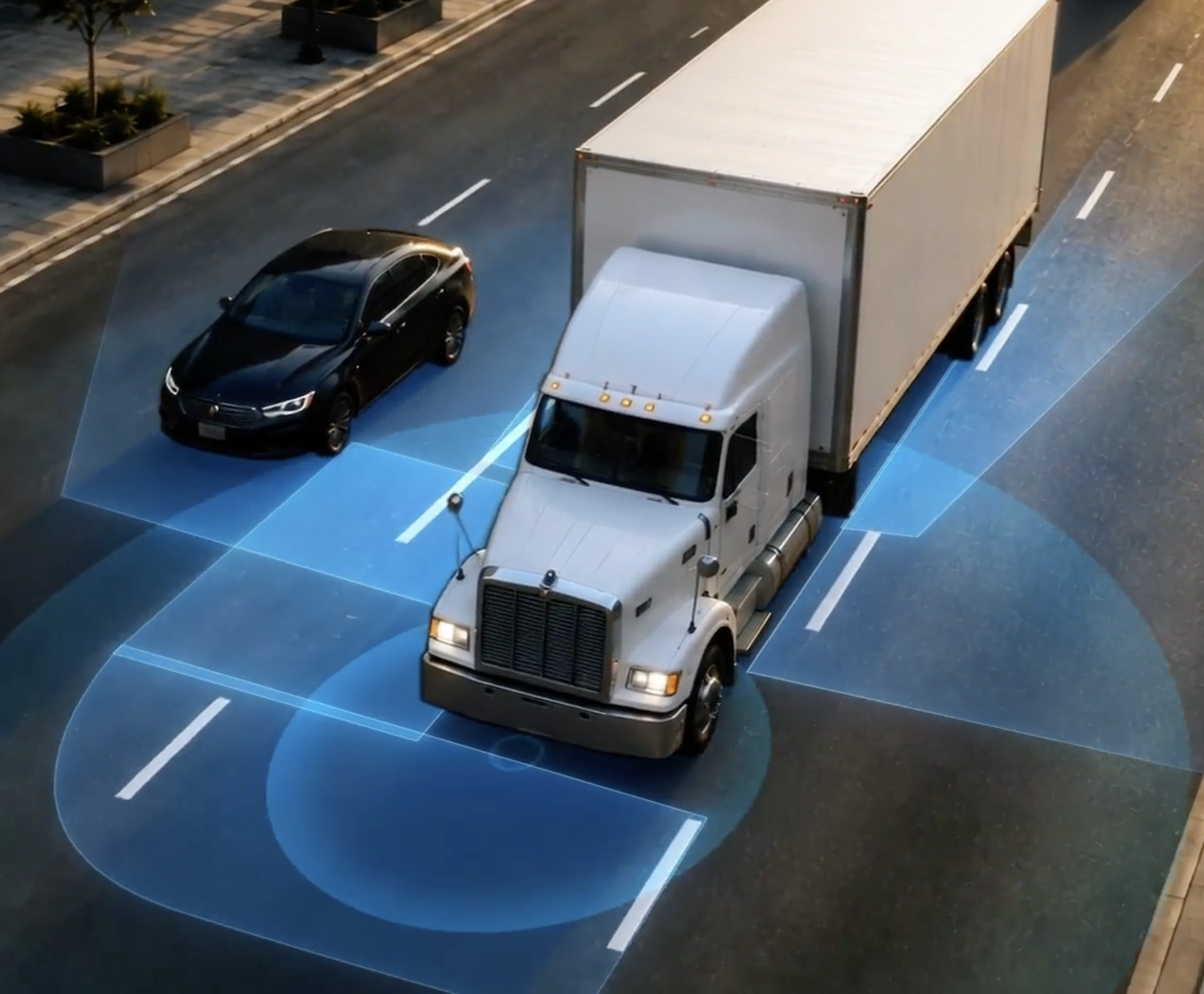
Perception Software
Resources
ADAS Sensing Architectures – Distributed or Central?
Explore the architectural challenges created by increasing sensor counts, real-time processing requirements, sensor fusion, and the trade-offs between distributed and centralized sensing architectures.
Increasing Sensor Adoption for Enhanced Driver Automation
Learn how cameras, radar, LiDAR, and ultrasonic sensors provide complementary capabilities for increasingly automated vehicles.
indie Launches Edge AI SoC to Power Smarter Perception Systems for Automotive and Humanoids
Explore how low-latency image processing, AI compute, and multi-modal sensor support are being integrated into next-generation edge-perception architectures.