
Mobile Robots (AMRs & AGVs)

Intelligent Perception for Autonomous Mobile Robotics
Autonomous Mobile Robots (AMRs) and Automated Guided Vehicles (AGVs) are transforming how materials, goods, and equipment move through industrial and commercial environments. As mobile robots become more intelligent, sensing and perception play an increasingly important role in helping machines interpret their surroundings and navigate dynamic environments.
Advanced vision systems can combine multiple cameras, high-performance image processing, geometric correction, Edge AI, and additional sensing modalities to transform raw sensor data into useful environmental information. Modern perception architectures designed for mobile robotics support multi-camera vision, 3D perception, 360-degree sensing, and multimodal sensor fusion.
Enabling Key Capabilities
Autonomous Navigation
Mobile robots require continuous information about their surroundings as they move through warehouses, manufacturing facilities, logistics environments, and other spaces.
Cameras and additional sensing technologies can provide environmental information to downstream navigation and control systems.
Processing this information close to the sensors can reduce latency and limit the amount of raw sensor data that must be handled by the robot’s central computing platform. Edge vision architectures can explicitly offload central computing resources while supporting real-time vision processing.
Obstacle and Object Detection
Vision and AI processing can support real-time video analysis, object detection, and scene understanding, while other sensing modalities like radar can provide complementary environmental information such as distance measurement.
Multi-Camera Perception
Current robotics-oriented vision architectures can support up to four cameras and eight independent video-processing streams simultaneously, providing a foundation for multi-directional machine vision.
3D Perception
3D perception cameras are specifically identified as an application within existing robotics vision-processing architectures.
360-Degree Vision
Multi-camera architectures can support 360-degree vision while processing several sensor streams simultaneously. 360-degree vision is explicitly listed among supported robotics applications.
Perception Software
Perception software is central to keeping mobile robots safe in spaces shared with people, vehicles, and equipment. By fusing data from multiple modalities, it detects obstacles, recognizes people, and predicts their movement in real time. As AMRs and AGVs take on more complex tasks in busy environments, reliable perception becomes the foundation for safe, efficient operation alongside human workers.
Why Advanced Perception Matters for Mobile Robots
As mobile robots incorporate additional cameras and sensors, the amount of information being generated increases significantly.
The perception architecture must manage:

Multiple camera streams
High-resolution image data

Image-processing workloads

Memory requirements

Processing latency
Data bandwidth
AI workloads
Multiple sensor modalities
Rather than sending every raw sensor stream to a large central processor, some perception functions can happen closer to the sensors.
A distributed architecture can therefore look like:
Sensors → Edge Processing → Edge AI → Perception → Central Compute → Robot Control
Image Signal Processing at the Edge
Before camera images can be effectively analyzed by computer-vision or AI algorithms, raw sensor information must first be processed.
An Image Signal Processor (ISP) provides this critical link between the image sensor and machine perception.
Advanced ISP architectures can support:

Multiple simultaneous cameras

High-dynamic-range imaging

Low-light optimization

Color processing

High-resolution sensors

Infrared-compatible sensor configurations

Low-latency processing
For mobile robots, the perception pipeline becomes:
Sense. Process. Understand. Interact.

Sense
Capture the surrounding environment through cameras and other sensors.

Process
Transform raw sensor information into optimized visual data.
Understand
Analyze the environment through computer vision and AI.
Interact
Provide perception information to higher-level navigation and robotic control systems.
Geometric Processing and Distortion Correction
Mobile robotic systems may use wide-field-of-view cameras to maximize coverage around the vehicle.
However, these optical systems can introduce geometric distortion.
Dedicated geometric-processing hardware can perform transformations before images reach AI and computer-vision algorithms.
Key Functions

Lens distortion correction

Image warping

Camera calibration

Electronic pan, tilt, and zoom

Multi-camera geometric processing
Dedicated eWarp geometric processing is integrated into current robotics-oriented vision architectures alongside the ISP.
This allows geometric image-processing workloads to occur within the vision pipeline rather than consuming additional central compute resources.
Managing Multi-Camera Data and Memory
A mobile robot equipped with multiple high-resolution cameras can generate a significant amount of image data.
Simply transferring all of that information into a central processor can increase:
Memory usage
Data bandwidth
Processing workloads
Component requirements
System complexity
A dedicated vision processor can handle camera workloads closer to the sensor.
One existing architecture, for example, can simultaneously support:
Up to 4 cameras
Up to 8 video streams
Up to 1,400 MP/s processing
Sub-1 ms ISP latency
No external DRAM
Edge AI for Mobile Robotics
Image processing prepares sensor data. Edge AI can help transform that information into higher-level perception.
Heterogeneous computing architectures can distribute workloads across specialized processing resources.
Neural Processing
Dedicated NPUs accelerate AI inference workloads.
Digital Signal Processing
DSP resources provide computing for real-time vision and conventional signal-processing workloads.
Application Processing
General-purpose application processors support operating systems and higher-level software.
Image Signal Processing
Dedicated ISPs process incoming camera streams before they reach AI workloads.
Geometric Processing
Dedicated processing hardware performs geometric transformations within the camera pipeline.
Video Encoding
Integrated H.264 encoding can provide multi-channel video compression and streaming.
Multi-Modal Perception
Mobile robots do not need to rely exclusively on cameras.
Different sensing modalities can provide complementary information about the surrounding physical environment.
Advanced ISP architectures can support:
Visible Cameras
Provide detailed visual information for machine vision and object recognition.
Infrared
Extends camera-based perception beyond conventional visible imaging.
Thermal
Provides additional information about objects and surrounding environments.
Depth and Time-of-Flight
Provide spatial and distance information.
Radar
Provides another modality for detecting objects and measuring environmental information.
LiDAR
Provides detailed spatial sensing that can complement camera-based perception.
Current Edge AI architectures for mobile robotics can support thermal, depth, IR, and radar inputs, while broader Physical AI platforms also identify ToF, Radar, and LiDAR as supported sensing modalities.
From Sensing to Autonomous Navigation
The perception architecture connects physical sensors with the intelligence used by an autonomous mobile system.
A scalable architecture can combine:
Multi-Modal Sensors
Cameras
IR
Thermal
Depth
Radar
LiDAR
Edge Sensor Processing
ISP
HDR
Geometric Processing
Edge AI
NPU
DSP
Computer Vision
Multi-Modal Perception
Central Compute
Navigation & Robot Control
Products
iND881

Edge AI Video Processor SoC
iND880
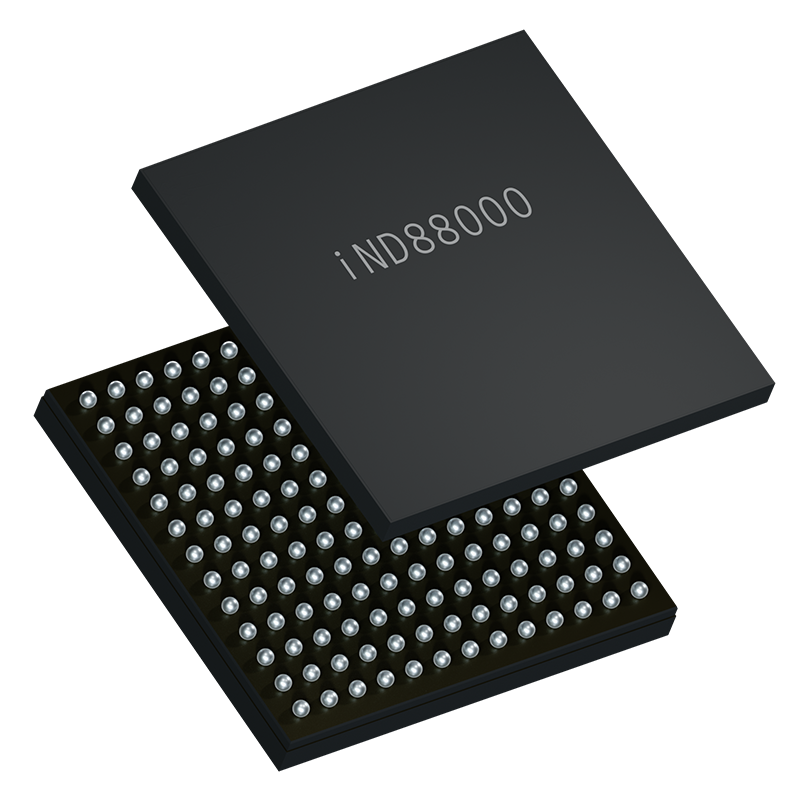
Camera Video Processor
Physical AI Software

Perception Software