
Drones

Drones
Drones are evolving from remotely operated platforms into increasingly autonomous systems capable of sensing, understanding, and responding to their environment in real time.
Vision is a critical part of this evolution. Multiple cameras, high-resolution image sensors, and additional sensing modalities generate large amounts of data that must be processed quickly and efficiently. Advanced image processing and edge computing help transform these sensor inputs into meaningful visual information for navigation, inspection, mapping, object detection, and autonomous operation.
Key Applications
Autonomous Navigation
Autonomous drones require continuous awareness of their surroundings to navigate complex environments. Camera-based perception provides visual information that can support environmental understanding, obstacle awareness, and autonomous decision systems.
Low-latency processing is particularly important because visual information must be captured and processed quickly enough to support responsive aerial systems.
Aerial Inspection
Drones can carry sophisticated camera systems for inspection applications where high-quality visual information is required. Image processing can enhance incoming sensor data before it is transmitted, displayed, stored, or analyzed by computer-vision algorithms.
Multi-Camera Perception
Using multiple cameras provides different viewpoints around the drone and can support wider environmental coverage.
Multi-camera architectures require significant image-processing capability to handle several high-resolution streams simultaneously while maintaining low processing latency.
3D and 360-Degree Vision
3D perception and 360-degree camera architectures can provide richer spatial information for autonomous aerial systems.
These systems rely on coordinated processing of multiple camera streams and accurate geometric processing to create useful representations of the surrounding environment.
Smart Camera Systems
Processing visual information directly within or near the camera can reduce the amount of raw image data that needs to be handled by the drone’s central computing platform.
Smart-camera architectures can combine image processing, geometric correction, video encoding, and AI acceleration at the edge.
Photonics at the Heart of Modern FOGs
The performance of a fiber optic gyroscope depends heavily on the quality of its optical source and integrated photonic architecture. Low-noise light sources, stable optical components, and efficient signal detection are essential for maximizing accuracy and minimizing drift.
Why Advanced Vision Processing Matters for Drones
High-resolution cameras generate large amounts of data. Adding multiple cameras increases these processing, memory, bandwidth, and power requirements.
Instead of sending every raw image stream directly to a central processor, dedicated vision processing can handle essential camera operations closer to the sensors.
Key Benefits

Real-time image processing

Multi-camera support

Low processing latency

High-dynamic-range imaging

Geometric image correction

Reduced central-compute workload

More efficient camera-data management

Support for computer vision and AI perception
This creates a more distributed architecture:
Cameras → Image Processing → Geometric Processing → Edge AI → Central Compute
Image Signal Processing (ISP) at the Edge
Before camera information can be effectively interpreted by AI or computer-vision algorithms, raw sensor data must first be processed.
An Image Signal Processor (ISP) performs this critical step, transforming sensor information into images optimized for viewing and machine perception.
For drone systems, a high-performance ISP can support:

Multiple simultaneous camera inputs

High-dynamic-range imaging

Low-light image processing
Color processing

Image enhancement

High-resolution sensor processing

Low-latency camera pipelines
Geometric Processing and Distortion Correction
Drone cameras frequently need wide fields of view to maximize environmental awareness.
Wide-angle optical systems can introduce geometric distortion. Dedicated geometric-processing hardware can correct and transform camera images before they are used for viewing, computer vision, or AI perception.
Key Functions

Lens distortion correction

Image warping

Camera calibration
Electronic pan, tilt, and zoom
Multi-camera geometric processing
This creates a straightforward perception pipeline:
Capture. Process. Correct. Understand.

Capture
Gather environmental information through one or multiple cameras.

Process
Transform raw sensor information into high-quality visual data.

Correct
Apply geometric correction and calibration to the camera image.

Understand
Deliver optimized visual information to computer-vision and AI workloads.
Related Products
iND880
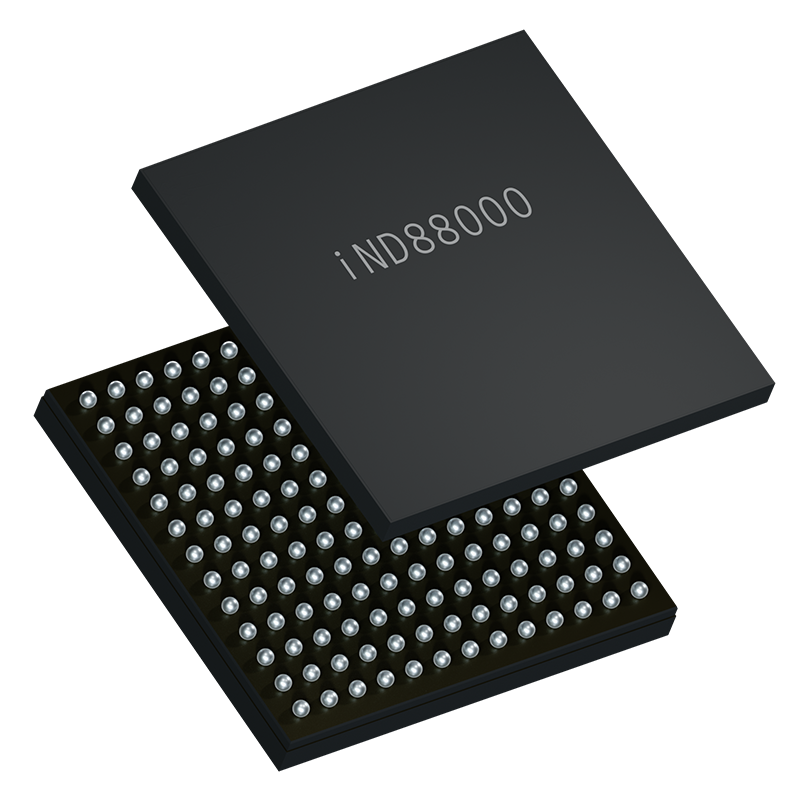
Camera Video Processor
iND881

Edge AI Video Processor SoC
Related Resources
indie Launches Edge AI SoC to Power Smarter Perception Systems for Automotive and Humanoids
Explore the transition toward intelligent edge perception using multi-camera processing, heterogeneous AI compute, and multi-modal sensing.
indie Semiconductor Introduces Class-leading Computer Vision Processor Family
Learn more about low-latency image processing, multi-camera architectures, high-dynamic-range imaging, and advanced ISP technology.