
Surround View Systems
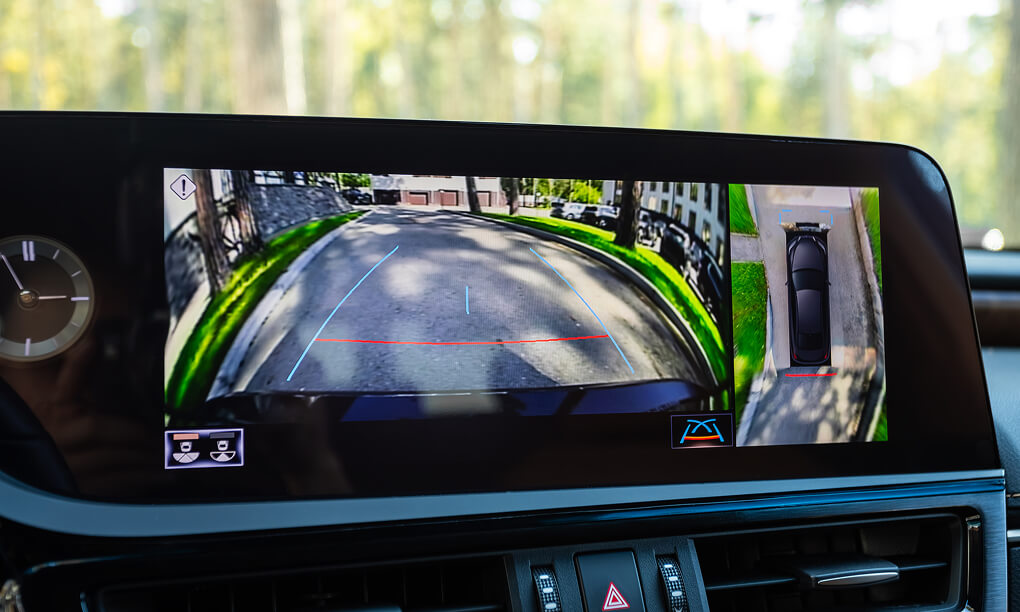
Surround View Systems combine multiple cameras positioned around the vehicle to create a comprehensive view of the vehicle’s surroundings. By stitching together images from front, rear, and side cameras, these systems help drivers better understand their environment, improving visibility during parking, low-speed maneuvers, and increasingly complex driving situations.
As vehicles adopt higher levels of automation and advanced driver assistance features, surround view systems are evolving beyond simple bird’s-eye displays into intelligent perception platforms that support greater environmental awareness and safety. Vision Processing technologies support applications including Surround View Systems, multi-camera processing, and advanced sensing architectures.
Key Applications
Parking Assistance
Provide a 360-degree view around the vehicle to simplify parking maneuvers and improve visibility in tight spaces.
Low-Speed Maneuvering
Enhance awareness of nearby obstacles, infrastructure, and vulnerable road users during low-speed driving situations.
Blind Spot Awareness
Improve visibility around areas that may be difficult to observe using traditional mirrors or individual camera views.
Automated Parking
Provide visual information that supports automated parking and driver-assistance systems.
Advanced Driver Assistance Systems (ADAS)
Support broader perception architectures by providing multiple camera views that can be used for sensing, visualization, and computer vision applications.
From Camera Input to 360° Awareness
A modern surround view architecture can be represented as:
Multiple Cameras → Image Signal Processing (ISP) → HDR & Geometric Correction → Image Stitching → Computer Vision & Edge AI → 360° Vehicle Awareness
The objective is to transform multiple raw camera feeds into a cohesive, intuitive view that enhances driver awareness and supports vehicle safety systems.
Key Benefits

360-degree vehicle visibility

Improved parking confidence

Reduced blind spots

Enhanced driver awareness

Improved obstacle detection

Support for ADAS functions

Better visibility in complex urban environments

Enhanced safety during low-speed maneuvers
Multi-Camera Vision Processing
At the heart of every surround view system is the ability to process multiple camera streams simultaneously.
These systems must manage several high-resolution image sensors while maintaining excellent image quality and low latency.
Advanced vision-processing architectures support:

Simultaneous multi-camera processing

High-resolution image pipelines

Real-time image enhancement

Multiple independent processing contexts

Support for visible and infrared imaging
High Dynamic Range Imaging
Vehicle cameras continuously encounter challenging lighting conditions.
A surround view system may need to simultaneously image:

Bright sunlight

Deep shadows

Parking garages

Tunnel entrances and exits

Nighttime environments

Reflections and glare
High Dynamic Range (HDR) imaging helps maintain image quality across these varying conditions.
HDR Benefits
Better visibility in direct sunlight
Improved shadow detail

Enhanced low-light performance

Improved scene interpretation

Greater image consistency
Image Stitching and Geometric Processing
One of the defining capabilities of a surround view system is generating a seamless view from multiple camera inputs.
To accomplish this, images must be corrected, aligned, and combined.
Key Processing Functions

Lens distortion correction

Camera calibration

Geometric transformation

Perspective correction

Image stitching

Bird’s-eye view generation
Low-Latency Situational Awareness
Visibility systems are only effective if information is delivered quickly.
Low-latency processing helps ensure that displayed information accurately reflects the vehicle’s current surroundings.
Benefits

Real-time driver feedback

Reduced display lag

Faster response to environmental changes
Improved confidence during maneuvering
Enhanced overall safety
Computer Vision and Edge AI
Surround view systems are increasingly moving beyond visualization and into perception.
Combining advanced image processing with AI enables systems to better understand what is happening around the vehicle.
Object Detection
Identify vehicles, pedestrians, cyclists, and obstacles within the vehicle’s surroundings.
Environmental Understanding
Provide contextual awareness of the surrounding environment and vehicle position.
ADAS Support
Supply visual information that can support parking assistance, automated driving features, and broader vehicle-perception systems.
Multi-Camera Analytics
Process multiple camera streams simultaneously while maintaining image quality and responsiveness.
Products
iND880
Camera Video Processor
iND881

Edge AI Video Processor SoC
GW5
Camera Video Processor
GW4

Camera Video Processor
Resources
Discrete ISP vs. SoC-Integrated ISP in Automotive ECUs – A Comparative Study
When it comes to designing automotive Electronic Control Units (ECUs) for vision-based applications, such as Advanced Driver Assist Systems (ADAS)…
Demonstrating Real‑World Perception Solutions and More at AutoSens and InCabin USA
AutoSens and InCabin USA continue to be a key event for automotive suppliers and OEMs, where the concentration of ADAS, in-cabin sensing, experience, and…