




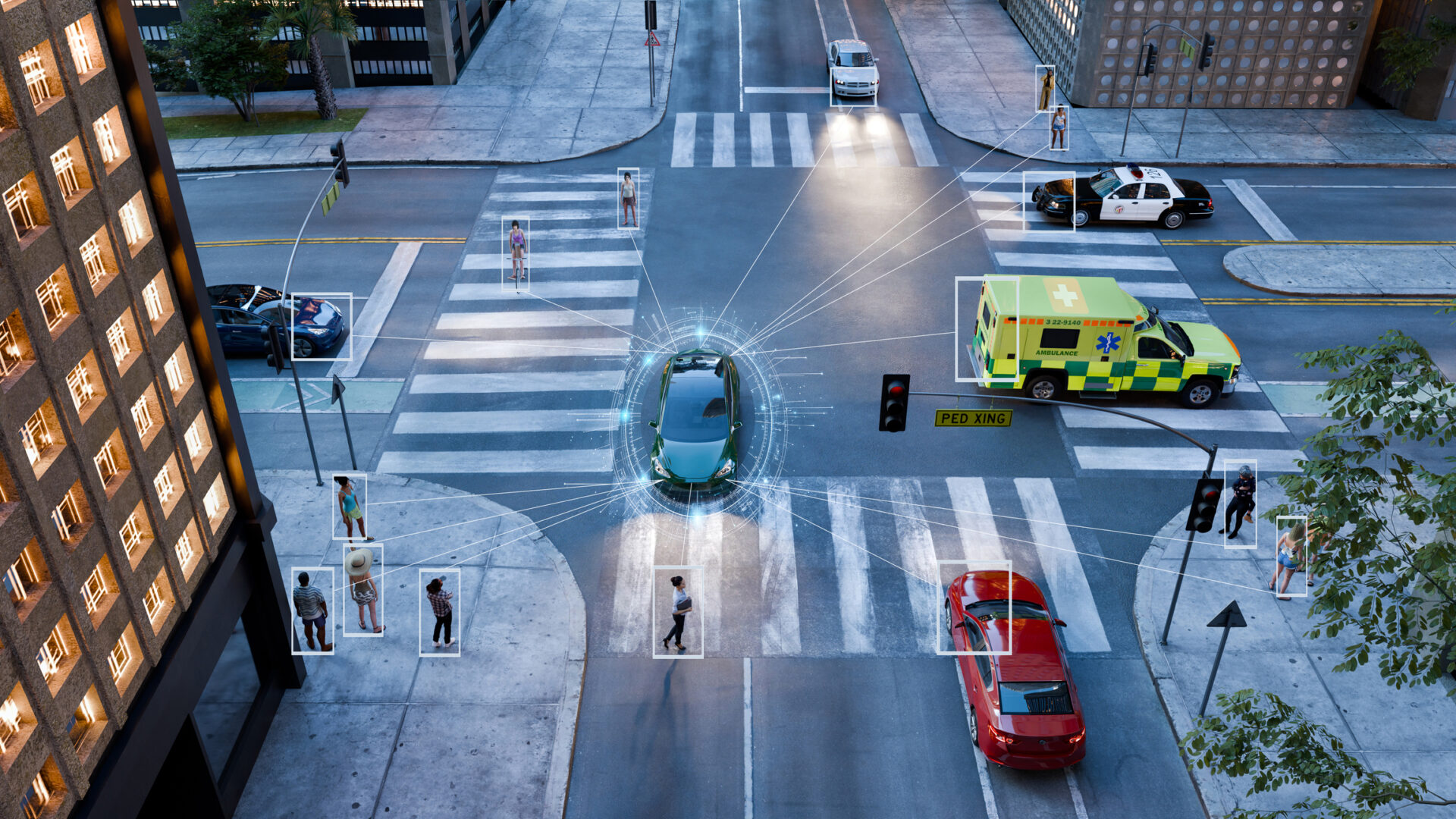
Automotive radar has steadily evolved from a convenience feature into one of the essential sensing technologies behind safer, more automated mobility. Early radar systems were primarily associated with blind spot detection (BSD). Today, radar is expected to support a much broader set of functions, including automatic emergency braking (AEB), lane-change assist, parking support, and long-range adaptive cruise control. New suppliers at higher frequency bands, including indie’s 120 GHz products, are enabling uses that 77 GHz systems were not designed for—especially complex near-field perception around the entire vehicle. 120 GHz radars will coexist in addition to 77 GHz products, while extending what near-field sensing can do.
This shift is significant as the vehicle environment is becoming more crowded and more dynamic. Drivers, pedestrians, cyclists, scooters, pets, shopping carts, curbs, doors, walls, and other vehicles all occupy the space immediately around the car. For automated parking and low-speed maneuvering, a system does not simply need to know that something exists. The vehicle needs to understand with high confidence where small objects and pedestrians are, the exact distance, and whether they are moving. This is where the conversation around higher-frequency radar becomes especially relevant.
The Short-Range Challenge
Many current radar platforms operate in the 76-81 GHz band, which has become the workhorse for automotive exterior sensing. It offers excellent all-weather performance, direct velocity measurement, and mature semiconductor and antenna ecosystems. For many long-range and mid-range applications, 77 GHz radar remains highly effective and will continue to play an important role in future vehicles.
However, the most demanding short-range use cases are pushing radar in a different direction. Low-speed automated driving and parking applications require accurate measurements very close to the vehicle. They must distinguish objects that are near one another, resolve surfaces and edges, and operate in tight packaging locations such as bumpers, corners, rocker panels, mirrors, and interior trim. In these environments, antenna size, resolution, update rate, and system integration are not secondary considerations. They define what the sensor can realistically deliver.
Why 120 GHz is Different
120 GHz FMCW radar brings several physics-based advantages that are particularly attractive for short-range sensing. The shorter wavelength enables smaller antennas and more compact RF structures, which can support smaller sensor modules and more flexible placement. Wider available bandwidth can improve range resolution, allowing the radar to separate targets that are close together in distance. At the same time, higher operating frequency can improve sensitivity to small motions and subtle changes in the scene.
In practical terms, this means a 120 GHz radar sensor can be designed to collect richer information from a physically smaller aperture. That is a powerful combination for applications where mechanical integration is difficult and where the sensing task is concentrated in the near-field. Rather than treating radar only as a long-range object detector, 120 GHz opens the door to more precise local perception.
Deployment in Automotive Applications
Early adoption of automotive use cases is likely to center on near-field advanced driver assistance systems (ADAS) and automated parking. Vehicles increasingly need to detect curbs, low obstacles, posts, walls, ramps, and pedestrians at short distances and from challenging angles. Ultrasonic sensors have traditionally served many parking functions, but the industry is moving toward more capable sensing architectures that can offer higher information content and more robust performance across environments.
120 GHz radar is also well matched to in-cabin and around-cabin sensing applications. The same characteristics that support high-resolution exterior sensing can also support in-cabin detection and sensing. The high sensitivity of FMCW radar to micro-motion can enable detection of extremely small physiological movements, including chest motion associated with respiration and heartbeat-related body movement. This capability is particularly valuable for child presence detection and pet detection applications, where a sleeping infant or animal may remain unnoticed by conventional sensing approaches. By identifying vital signs even when occupants are stationary or obscured, radar can provide an additional layer of safety while supporting increasingly stringent in-cabin monitoring requirements.
For automakers trying to improve safety and user experience while managing the number of sensors on the vehicle, a compact radar platform that can support multiple functions becomes increasingly appealing.

More Information from Less Space
One of the most important system-level benefits is packaging. Vehicle designers do not have unlimited space for sensors, wiring, brackets, heaters, protective covers, and service access. A technology that enables smaller antennas and integrated radar modules can reduce mechanical complexity and create more freedom for vehicle design and sensor placement. That matters not only for premium vehicles but also for mass-market vehicles where cost, manufacturability, and repeatability are critical.
An additional benefit is vehicle integration and styling. Ultrasonic systems often rely on multiple visible sensors requiring holes, brackets, and dedicated mounting features in exterior body panels. Compact 120 GHz radar modules can be hidden behind vehicle surfaces, enabling cleaner vehicle designs while potentially reducing manufacturing and assembly complexity.
At the system level, better near-field resolution may also reduce the need for additional sensors, which add to the overall bill of materials. The ultimate value of radar architecture is not measured only by the cost of the silicon or the sensor module. It is measured by the vehicle function it enables, the integration burden it reduces, and the confidence it provides to the ADAS or automated parking stack.
A Complementary Modality, Not a Replacement
The future of radar is not a simple story of one frequency replacing another. 77 GHz radar will remain an important technology for many exterior sensing applications for many years to come. Rather than replacing existing radar capabilities, 120 GHz should be deployed to complement them, enabling use cases that require precise short-range performance, smaller device footprints, and more detailed local information.
As vehicles become more automated, OEMs and Tier-1 suppliers will continue to evaluate sensing architectures by function, cost, package, and performance. 120 GHz FMCW radar adds a powerful new option to that architecture toolbox. It allows system designers to think beyond traditional radar placement and begin asking where a compact, high-resolution sensor could enable new safety and convenience features.
Looking Ahead
Automotive radar has evolved from a niche driver-assistance technology into a foundational sensing modality, delivering highly accurate range and velocity measurements with reliable all-weather performance. While OEMs initially deployed radar for applications such as adaptive cruise control and emergency braking, the next generation of automotive perception demands significantly higher resolution, richer environmental awareness, and greater integration with software-defined vehicle architectures. At indie, we recognize that these advancements are built on decades of innovation and the accelerated deployment of high-frequency radar sensors worldwide. Leveraging deep expertise in RF design, signal processing, advanced packaging, automotive qualification, functional safety, and high-volume manufacturing, we develop complete radar platforms optimized for real-world automotive and industrial use cases. By taking a system-level approach, from phase noise optimization and waveform generation to sensor integration and mass production readiness, indie delivers differentiated radar solutions that enable the next generation of intelligent and automated systems.
The industry increasingly requires sensors that can operate reliably in challenging environments, fit within ever more constrained vehicle architectures, and provide actionable data to higher-level perception systems. This is where 120 GHz FMCW radar is emerging as a powerful next step. By enabling higher-resolution, more compact implementations and enhanced short-range sensing performance, 120 GHz radar technology opens the door to new applications throughout the vehicle. Through its continued investment in high-frequency radar innovation, indie is helping drive this evolution and unlock the full potential of next-generation sensing.
Learn more