 Functional Diagram
 Sales & Technical Support
Applications
- Collision Avoidance
- Industrial Sensing
- Vital Sign Detection in Healthcare
- Predictive Maintenance of Rotating Machines
- Material Analysis
- Quality Control
Features
- Radar front-end (RFE) with on-chip antennas for 122-GHz ISM band
- Single supply voltage of 3.3 V
- Fully ESD protected device
- Low power consumption of 380 mW
in continuous operating mode - Integrated low phase noise push-push VCO
- Receiver with homodyne quadrature mixer
- RX and TX dipole on-chip antennas
- Large bandwidth of up to 7 GHz
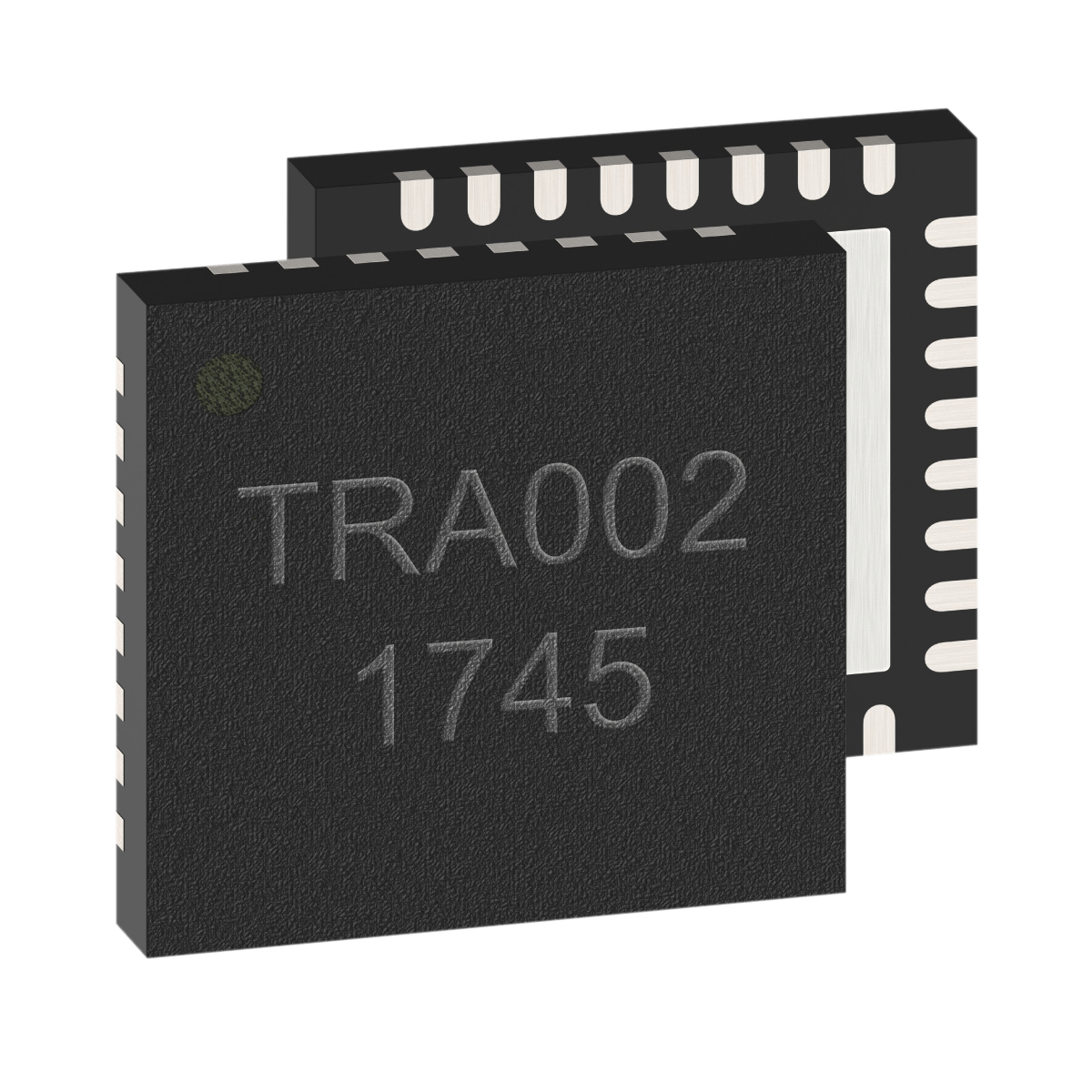
- QFN32 leadless plastic package 5 x 5 mm²
- Pb-free, RoHS compliant package
- IC is available as bare die as well
Resources
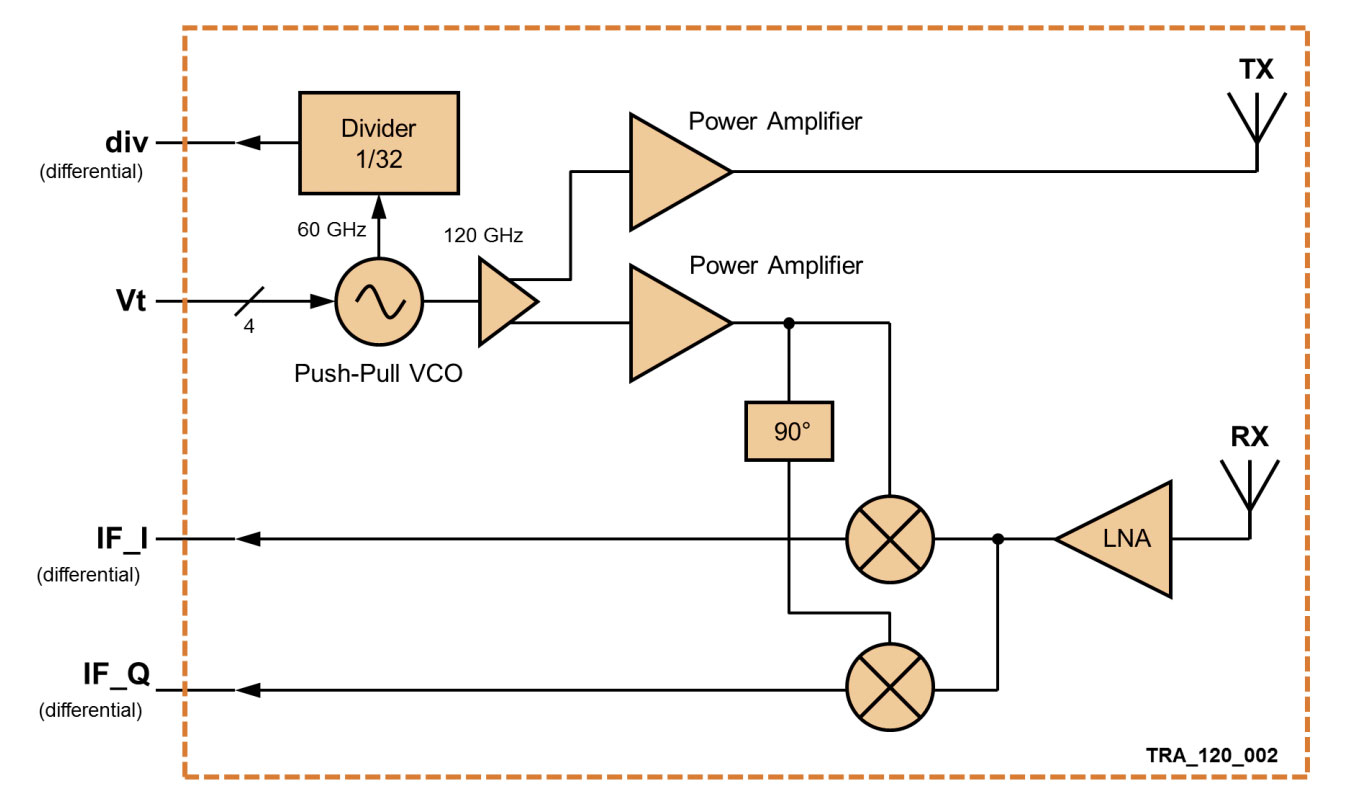
Functional Diagram

| Product Details | |
|---|---|
| Product | TRA_120_002 |
| Frequency | 120 GHz |
| Frequency Range (Min/Max) | 119.3/125.8 GHz |
| Operation Mode | FMCW/CW |
| Single Supply Voltage | 3.3V |
| Current Consumption | 128mA |
| Package | QFN 32: 5 x 5 mm² |
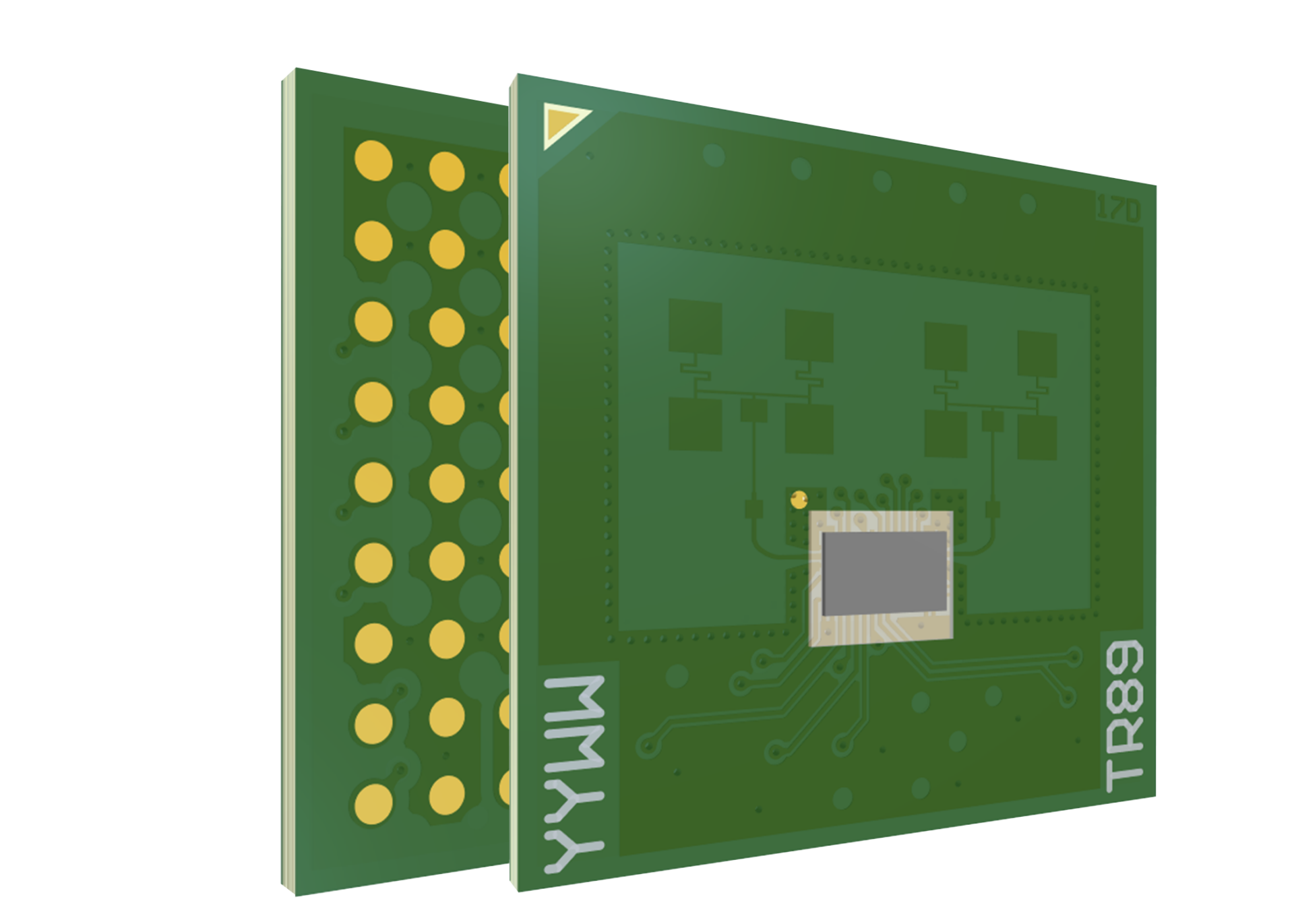
The focus of radar MMIC TRA_120_002 is on maximum integration. Here, both antennas, one for the transmitter and one for the receiver branch, are monolithically integrated into the chip to offer the smallest size and loss.
Application
The radar chips provide measurement signals for distance and speed measurement of objects as an analog signal. In combination with a subsequent external signal evaluation at the customer side, possible applications are the investigation of material surfaces, the measurement of layer thicknesses and other properties of the measured objects. The main application area of the 120 GHz transceiver radar front-end is for short range radar systems with an operation range of up to 10 meters. By using dielectric lenses or mirrors, the range can be increased beyond 100 meters.
In addition, radar is a widely deployed long range sensing solution for safety and convenience features such as automated emergency braking (AEB), automated parking and adaptive cruise control (ACC), leveraging frequencies between 76 to 81 GHz. As vehicle OEMs look to continually improve sensing resolution, radar is now becoming increasingly important for in cabin Driver and Occupant Monitoring Systems (DMS/OMS), leveraging higher frequencies from 120 to 140 GHz enabling vital sign detection, including heartbeat and respiration, to ensure occupant safety. These higher, license-free frequencies also support the use of antenna-on-chip techniques that significantly simplify PCB design, minimize sensor form factor, and reduce cost criteria, which is particularly important for DMS/OMS applications where external antennas impose industrial design limitations unacceptable to automotive manufacturers.
No Handling of High Frequencies on the PCB
The high-frequency radar signal is already converted to a lower frequency in the radar front-end IC. The IC’s output is an analog signal with a frequency of max. 2 GHz. This allows for routing and signal processing of all signals on cost-efficient PCBs. It can, therefore, be implemented on standard FR4 boards and combined with other IC components for control loops, voltage stabilization, frequency modulation, and AD conversion.
Bare Die
These chips are also available as bare die when bought in large quantities. For more information, please contact our sales department.
Evaluation Board
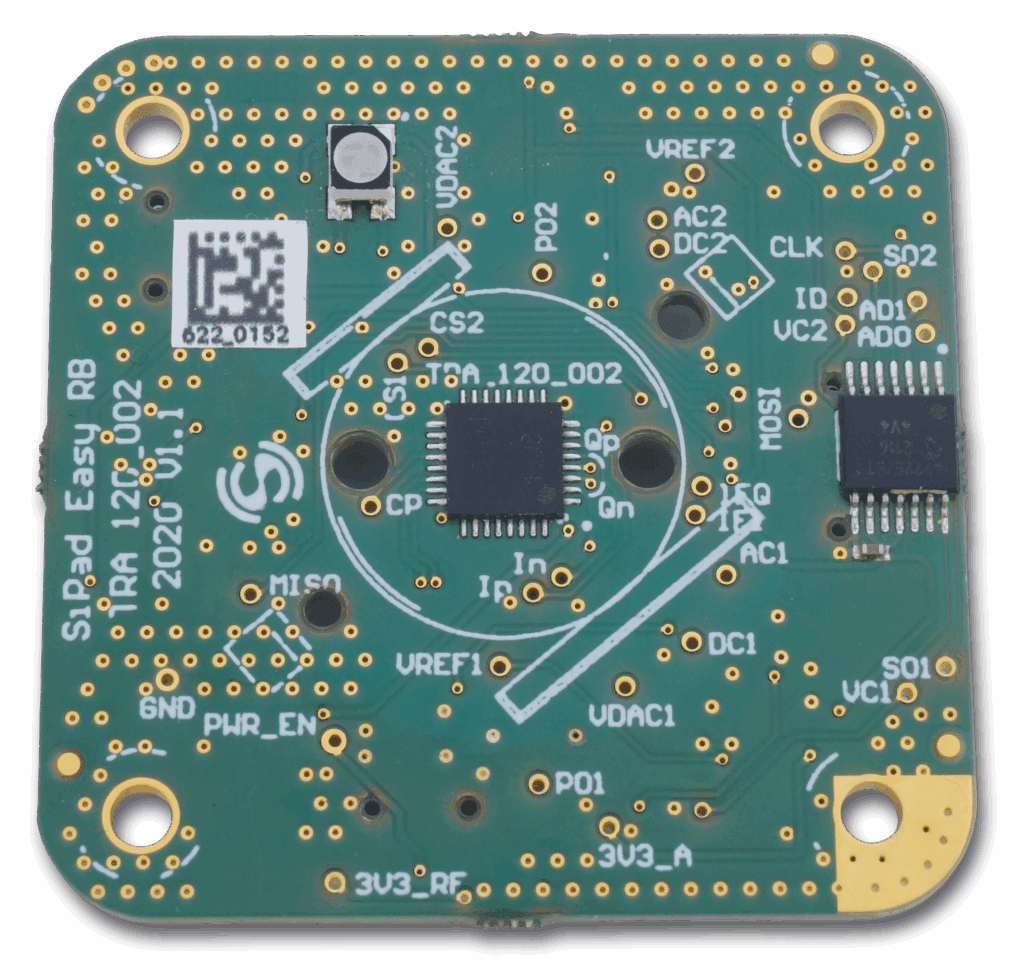
indie is pleased to offer an Evaluation Board with our TRA_120_002 for the SiRad Easy r4 platform.
Related Products
| Product | Description | |
|---|---|---|
24 GHz Radar Transceiver |

|
|
120 GHz Transceiver Front-end |
|
|
120 GHz Radar Transceiver Front-end |
|
|
SiRad Easy® r4 is an advanced and comprehensive system to evaluate our radar front ends |
|