



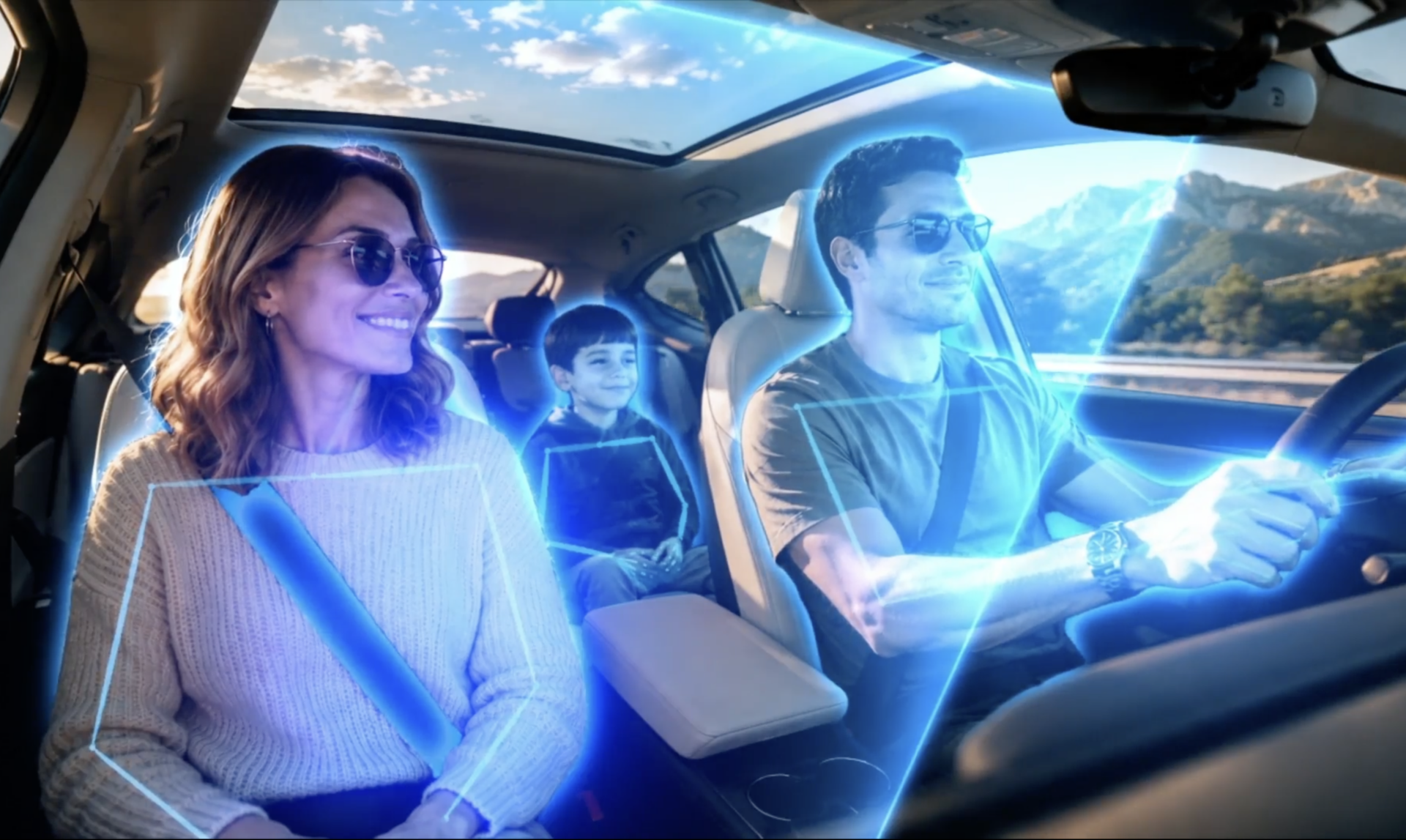
Driver and occupant monitoring systems (DMS/OMS) are becoming mandatory in large parts of the world. In Europe, DMS is now driven by regulatory requirements and NCAP safety-rating criteria, while adoption is accelerating in China, Japan, and North America as advanced driver assistance systems (ADAS) and higher levels of vehicle automation become more prevalent, which require DMS for safe use. As a result, OEMs increasingly view DMS/OMS as foundational elements of next-generation vehicle platforms.
A growing number of programs are consolidating compute into large central ECUs, with infotainment, Advanced Driver Assistance Systems (ADAS), connectivity, and now in-cabin perception – all competing for the same compute resources and memory bandwidth. While centralized processing is efficient in principle, in practice engineering teams repeatedly encounter central ECUs running out of resources, leaving Tier 1s and OEMs needing to offload certain components, often under strict deadlines. Complicating matters further, the camera, in-cabin perception software, and system-on-chip (SoC) are frequently sourced from different vendors; no single party is ultimately accountable when the system doesn’t come together as expected. These issues often surface during integration, sometimes just months before production begins.
Moving Perception to the Edge
A more robust approach is to remove real-time in-cabin perception from the central ECU altogether, and instead process it locally, or on a dedicated edge device built specifically for that function.
This shift directly addresses each of the issues outlined above. Performance becomes predictable, since the edge device is not competing for cycles with other workloads. The central ECU is freed from carrying this load, preserving headroom for the remaining functions. The edge device provides an optimized architecture for the specific task it was designed to do. In addition, as regulatory feature sets evolve rapidly, a smaller dedicated ECU also lets OEMs adapt more quickly to the market.
The Requirements
Moving in-cabin perception to the edge is the correct architectural direction. The next step is to enable automotive-grade, real-time, multi-modal DMS/OMS performance on a single edge device that fits within the camera module’s power and thermal constraints. indie’s iND881 SoC and emotion3D DMS/OMS software deliver this capability.
indie’s emotion3D in-cabin perception software stack is production-proven and already deployed with many Tier 1 suppliers and OEMs. It covers active safety, passive safety, user experience (UX), and automation features, satisfies mandatory regulatory requirements, and is engineered for low processing overhead, so it does not depend on central compute-level resources.
The iND881 edge AI SoC is also purpose-built for this class of workload. Its heterogeneous architecture combines an NPU, a DSP, and a quad-core Arm Cortex-A53 CPU, allocating each task to the compute resource best suited to it. It supports multiple camera inputs with a high-dynamic-range ISP that independently optimizes the infrared and visible (RGB) streams for DMS and OMS. It also works with diverse DMS/OMS sensor types, such as visible RGB, infrared, radar, and depth sensors. A built-in hardware security module addresses automotive cybersecurity as well as Functional Safety requirements. The iND881 is the next-generation vision-processing SoC, building on the established iND880 architecture, known for its ultra-low power embedded operation.
The Value of Co-Design
Each solution delivers strong standalone performance and is available to customers independently. However, in DMS/OMS programs, the greatest risk typically lies not in the hardware or software themselves but in their integration. By offering customers a fully validated bundled solution, we can reduce integration complexity and risk, accelerate deployment, and improve overall program confidence.
The iND881 and emotion3D in-cabin perception software form a proven, production-ready platform that has been developed and validated as a unified solution. Unlike approaches that require software to be adapted and optimized after hardware selection, indie’s emotion3D software is designed, tested, and validated directly on the silicon it is intended to ship on. This eliminates third-party IP dependencies, reduces integration complexity, and avoids the risk of unforeseen compatibility issues later in the development cycle. As a result, customers benefit from a de-risked deployment path, faster time to market, and the simplicity of working with a single technology partner from proof-of-concept through series production.

In-Cabin Solution of the Year
Central ECUs will remain a core element of future vehicle architectures. However, as automakers continue to consolidate an increasing number of functions onto shared compute platforms, resource contention, integration complexity, and system-level dependencies can introduce risks that often surface late in the development cycle, when mitigation is most costly. A dedicated, purpose-built edge solution provides a more predictable path to production by offloading critical workloads to a platform specifically designed and validated for the application. With hardware and software developed and optimized together, automakers gain a proven, production-ready solution and the accountability of a single partner responsible for system-level performance, reducing integration uncertainty and accelerating deployment.

Perception Software

System-on-Chip (SoCs)
Learn more:
Reimagining the Image Processor for Multi-Camera Vision Systems
By moving image processing out of the SoC, discrete ISP architectures can cut latency, improve efficiency, and enable higher performance in multi-camera vision systems.
Discrete ISP vs. SoC-Integrated ISP in Automotive ECUs – A Comparative Study
When it comes to designing automotive Electronic Control Units (ECUs) for vision-based applications, such as Advanced Driver Assist Systems (ADAS), surround…
Demonstrating Real‑World Perception Solutions and More at AutoSens and InCabin USA
Learn how Edge AI, perception software, DMS/OMS platforms, and in-cabin sensing technologies are evolving to support next-generation occupant monitoring systems.