




By Fred Jarrar, Vice President & General Manager, Power & ASIC BU
The automotive industry is experiencing a period of rapid innovation, particularly in the development of advanced driver-assistance systems (ADAS). The value of sensors for ADAS and electrification is growing at 17% CAGR and will reach $3 billion in 2029, according to Yole Group. High-resolution cameras and in-vehicle displays are becoming standard components of ADAS systems, generating substantial data volumes that require robust and efficient data transmission. The Automotive SerDes Alliance’s Motion Link technology, ASA-ML, is emerging as a compelling open standard architecture, not least for its ability to link multiple sensors to automotive engine control units (ECUs) over long distances with high bandwidth, low latency, low-power serialization and deserialization (SerDes).
What advantages does ASA-ML offer for automotive data transport?
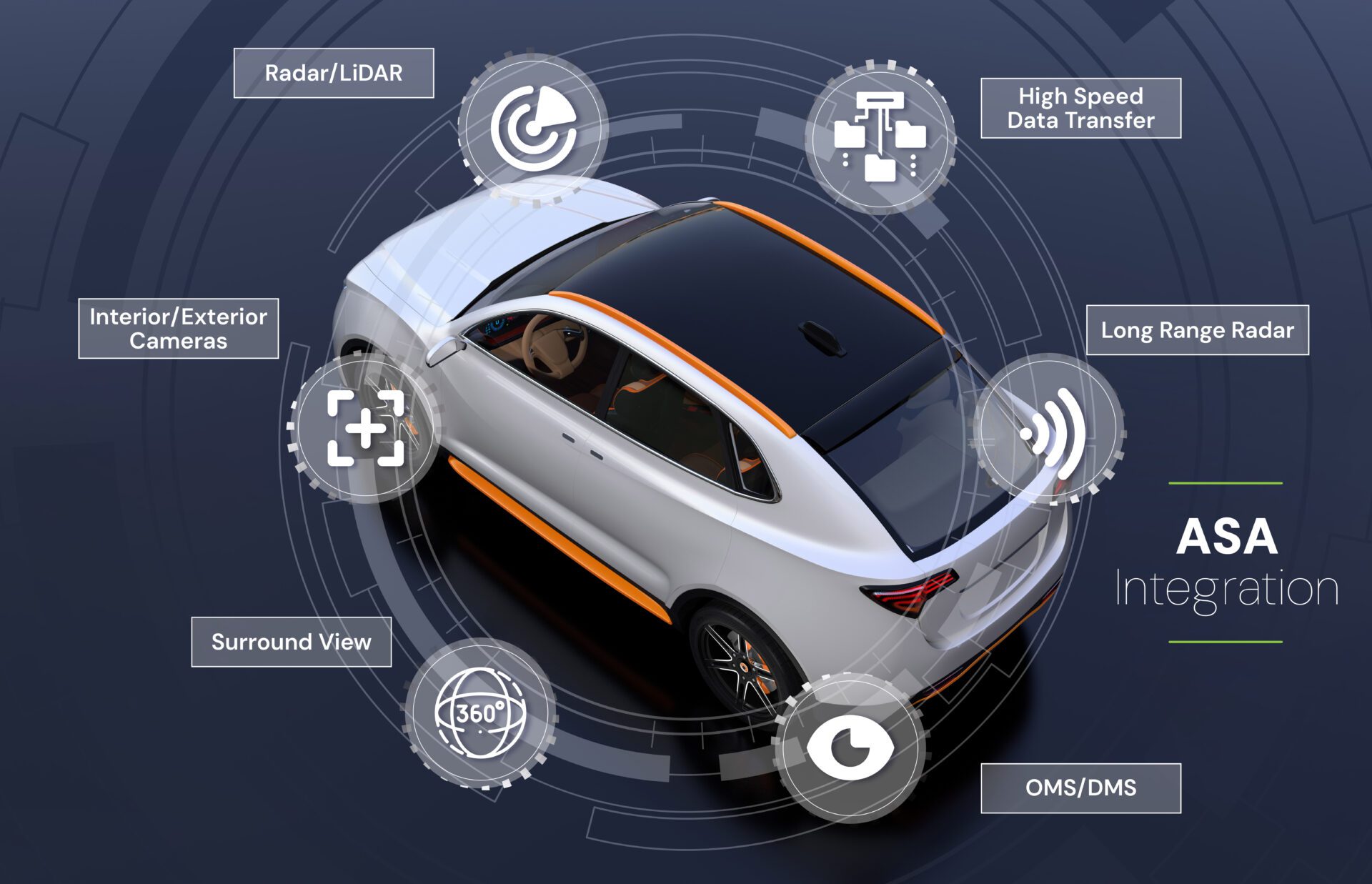
High Data Rates and Scalability: ASA-ML is engineered to support the high data transmission rates required by high-resolution cameras, radar, and LiDAR systems, enabling real-time performance. With downlink and uplink data rates of up to 16 Gbps and 4 Gbps, respectively, its scalable architecture facilitates the integration of numerous ADAS sensors. This is crucial for next-generation ADAS functionalities, including 360-degree camera systems, to provide drivers with better situational awareness and safety through real-time communication with other vehicles and infrastructure.
Interoperability and Flexibility: ASA-ML promotes interoperability, fostering a diverse ecosystem of compatible solutions from various vendors. This open standard simplifies integration across different sensor and control unit configurations, offering flexibility in design and potentially reducing development costs. In addition, ASA has liaison partnerships with MIPI, Vesa and HDMI standards bodies, so support is provided for these encapsulated protocols.
Low Latency and High Signal Quality: Low latency is critical for safety-related ADAS applications like adaptive cruise control, lane departure warning, and automatic emergency braking. ASA-ML is designed to deliver data with minimal latency, ensuring rapid response times for real-time processing. Advanced error correction and equalization mechanisms enhance signal integrity, maintaining high data quality across extended transmission distances and ensuring the absence of bottlenecks.
Efficient Power Management: Power efficiency is an important consideration in automotive applications, especially for electric vehicles, where it can impact range. Power efficiency is also critical for multi-camera systems. Each camera and sensor draws power simultaneously, and without optimization for power usage, it can quickly drain the vehicle’s battery, reducing the vehicle’s range. ASA-ML integrates efficient communication protocols that minimize data transfer power or reduce bandwidth requirements. For example, ASA-ML uses Time Division Duplexing (TDD), a technique that allows for efficient data transmission in both directions (downstream and upstream) over a single physical link, reducing the need for separate wires and power consumption.
How ASA-ML SerDes Bridges for MIPI C-PHY/D-PHY Extend Communications Reach
A key benefit of ASA-ML is its ability to extend the reach of short-distance MIPI C-PHY/D-PHY interfaces. MIPI interfaces are often optimized for short-range connections, which can limit the placement of high-resolution cameras or sensors relative to the central control unit. ASA-ML SerDes bridges effectively extend this range, perhaps up to 15 meters, enabling longer-distance data transmission while preserving signal integrity. This approach offers an open and standardized alternative to proprietary long-distance SerDes, streamlining integration and encouraging broader adoption within the industry.

How Much Industry Support is There for ASA-ML?
The Automotive SerDes Alliance (ASA) has over 150 active member companies. Members include major automobile manufacturers such as BMW, Ford, GM, Hyundai Kia Motor Company, Nio, Renault/Ampere, Stellantis, Volvo Trucks, and Xiaopeng Motors. Leading the way, BMW Group announced plans to adopt ASA-ML and demonstrated the technology at the Automotive Ethernet Congress in Munich in March 2024. In addition, tier-one suppliers, semiconductor vendors, cable and connector manufacturers, test tool vendors, and test houses have joined the alliance. This growing interest indicates a move toward open standards that provide enhanced performance, improved interoperability, and a future-proof infrastructure, paving the way for the advancement of efficient ADAS architectures and the broader deployment of automated vehicles.
How is indie supporting the growing interest in ASA-ML
indie’s next-generation high-speed data converter is an ideal component for converting MIPI C/D PHY signals to ASA, bridging the gap between short-distance MIPI interfaces and long-distance ASA-ML data transmission. The converter facilitates seamless data transmission over extended distances, ensuring reliable communication between multiple camera, radar, or LiDAR sources and the vehicle’s central processing unit.
The converter, for example, designed to complement indie’s iND880 series of camera video processors (CVPs), consists of versatile dual-input high-speed streams, enabling the simultaneous processing of multiple cameras. ASA signals are converted back to CSI-2 format, which is then fed into these devices for real-time processing. This end-to-end solution simplifies integration, improves signal integrity, and reduces overall system complexity.
Conclusion
As the automotive industry advances, high-performance data transmission solutions become increasingly critical. ASA-ML offers notable benefits in data rates, scalability, interoperability, and the ability to extend MIPI interface range via SerDes bridging. This facilitates end-to-end data transmission from camera sensors to processing units, contributing to safer, more intelligent vehicles equipped for the future.