


 Product Brief
 Sales & Technical Support
Features
- Low Insertion Loss
- Cost-Effective
- Wide Spectral Coverage
- Compatible With High-Speed Data Transmission
- Massive Dispersion Levels
- Configurable Dispersion Settings
- Ultra-Compact
Applications
- Testing Coherent Transceivers
- Testing Long-Distance IMDD-Type Signals

Patrice Dionne
Product Line Manager
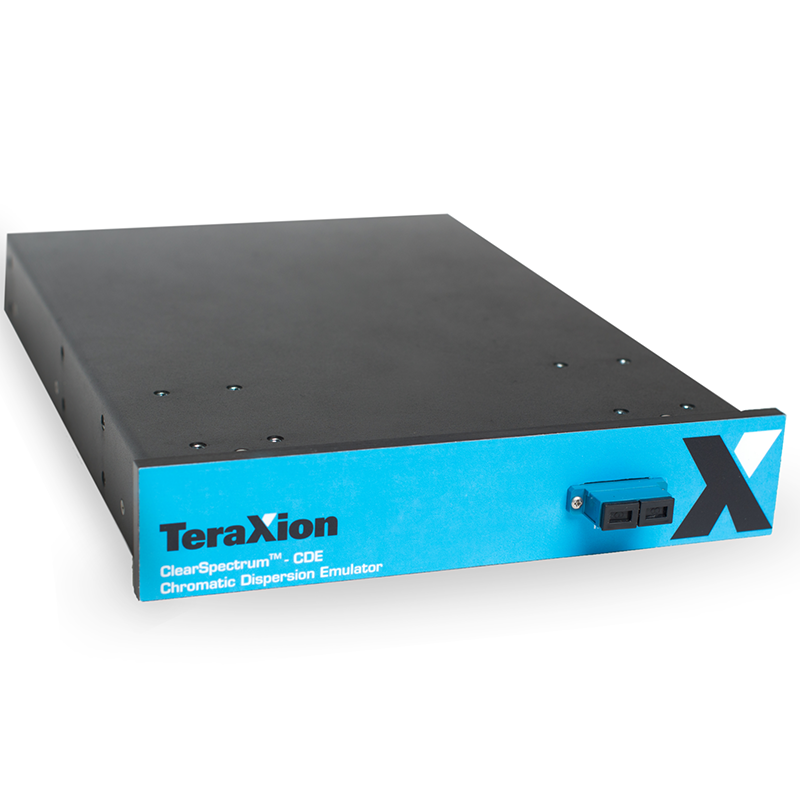
indie developed the CDE as a space-saving and cost-effective solution for researchers who need to emulate the chromatic dispersion of hundreds or even thousands of kilometers of fiber. The ultra-low insertion loss also reduces the number of amplifiers required for long-haul emulation, trimming expenses while saving laboratory space.
indie’s exclusive Fiber Bragg Grating (FBG) technology enables the CDE to emulate high levels of dispersion in the most practical and efficient way.
Key Features and Benefits
Low Insertion Loss:
The CDE significantly reduces the accumulated insertion loss caused by hundreds or thousands of kilometers of transport fiber, thus reducing the number of amplifiers needed when emulating very long fiber links.
Cost-Effective:
The CDE eliminates the cost of purchasing and storing large fiber spools and reduces the number of amplifiers needed for long-haul transmission emulation.
Wide Spectral Coverage:
In its single-channel configuration, the CDE provides an impressive 350 GHz operation bandwidth at a fixed optical frequency, which can be manufactured anywhere within the C-band or L-band. The multi-channel version enables simultaneous dispersion emulation for multiple telecommunication channels within these bands, supporting operation bandwidths of up to 150 GHz. With customizable channel spacing and optical frequency, the CDE seamlessly aligns with telecommunication standard and custom requirements.
Optical frequencies in the O-band are available upon request for both single- and multi-channel configurations.
Compatible with high-speed data transmission:
The CDE’s wide spectral coverage enables dispersion emulation for high-baud-rate signals. For example, a 150 GHz operational bandwidth can accommodate 400G DP-QPSK (100 GBd), 800G DP-32QAM (80 GBd), and 800G DP-64QAM (100 GBd), ensuring accurate dispersion emulation without spectral truncation.
Massive Dispersion Levels:
Each CDE module emulates dispersion up to 45,000 ps/nm—equivalent to approximately 2,650 km of fiber. For even greater dispersion, multiple modules can be cascaded, making it possible to replicate the dispersion characteristics of submarine networks.
Configurable Dispersion Settings:
Each CDE module supports multiple dispersion levels, typically offering three predefined settings per module. For example, a 45,000 ps/nm module can be configured to emulate 15,000, 30,000, and 45,000 ps/nm, providing a flexible and efficient approach to dispersion emulation.
Ultra-Compact:
The CDE is available as either half 1U 19-inch rack-mountable or benchtop modules.
| Product Details | |
|---|---|
| Emulation Level | Up to 45 000 ps/nm per module (multi-channel) and 15,000 ps/nm (single-channel) |
| Operational Bandwidth | Up to 150 GHz (multi-channel) and 350 GHz (single-channel) |
| Insertion Loss | As low as 0.011 dB per kilometer emulated |
Example of spectral coverage for various CDE configurations

Compatibility of different configurations with different telecommunication standards.

Related Products
| Product | Description | |
|---|---|---|
Offering combined dispersion compensation and emulation in a compact, cost-effective instrument. |

|