




Ultrafast Lasers
What Are Ultrafast Lasers?
Unlike continuous wave (CW) lasers, which emit energy steadily over time, ultrafast lasers release their energy in exceedingly short bursts, typically lasting only a few tens or hundreds of femtoseconds. As a reference, a femtosecond represents a staggering one millionth of a billionth of a second. This feature allows ultrafast lasers to achieve exceptionally high peak powers (P_peak) for a given energy (E) in the system, as described by the relationship:
Ppeak = E / 𝜏,
where τ represents the pulse duration. The shorter the pulse duration, the higher the peak power that can be attained. This makes femtosecond lasers—commonly referred to as ultrafast lasers—highly advantageous for applications requiring high radiation intensities.
Most femtosecond lasers are generated by a mode-locking mechanism, which yields a stable solution in steady-state operation. This translates into a pulse train for which all impulsions have the same optical parameters and are equally spaced in time. Typical pulse repetition rates of mode-locked lasers are on the order of tens of megahertz.
Another critical benefit of ultrafast lasers lies in their unique interaction with materials, due to their ultrashort pulse durations. These durations are shorter than the thermal response time of most materials, including biological tissues. As a result, even when very high peak powers are focused on a sample, the thermal effects can be minimized if the average power is maintained below a certain limit. This property is invaluable for precision tasks, such as imaging biological tissues, where minimizing collateral thermal damage is crucial, particularly in vivo.
The spectral characteristics of ultrafast lasers also merit attention. In CW operation, lasers typically exhibit a narrow linewidth, especially when propagating only a few modes. In contrast, pulsed lasers can have significantly broader spectral widths, particularly for shorter pulse durations. The very broad spectrum of ultrafast lasers can be advantageous in applications such as spectroscopy and imaging, where a wide range of wavelengths can provide richer information or better resolution.
In summary, ultrafast lasers offer unmatched peak powers, minimal thermal effects during material interactions, and broad spectral characteristics, making them indispensable in a variety of scientific and industrial applications.

A Key Technology for Multiphoton Microscopy and Terahertz Generation
Multiphoton Microscopy
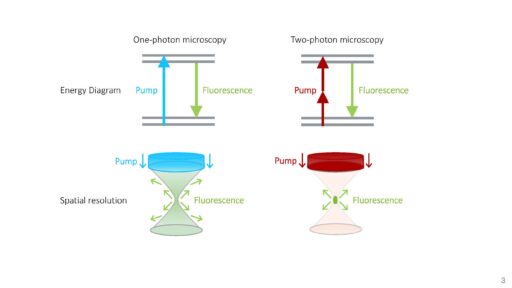
Multiphoton microscopy (MPM) is a powerful imaging technique widely used in biological and biomedical research. Unlike traditional fluorescence microscopy, which relies on single-photon excitation, MPM involves the simultaneous absorption of multiple photons to excite a fluorescent molecule. The total photon energy required to reach the fluorescence excitation level is distributed among the photons involved. Since photon energy is inversely proportional to wavelength, MPM allows the use of longer wavelengths compared to single-photon excitation. This reduces potential photodamage and enables deeper tissue penetration, as longer wavelengths scatter less in biological tissues.
Achieving simultaneous photon absorption in MPM requires high photon densities, because the fluorescence process scales non-linearly with radiation intensity. This non-linear scaling in MPM enhances spatial resolution, as fluorescence occurs only at the tightly focused spot of the light, where photon density is highest. In contrast, for single-photon imaging, fluorescence will occur in more diffuse areas as well because the process scales linearly with intensity.
As ultrafast lasers yield unmatched peak powers during very short periods of time, they provide the high photon densities needed for MPM while having minimal unwanted thermal interaction with biological tissues.
Near-infrared wavelengths are typically used for the most common type of MPM: two-photon imaging. These wavelengths can be selected to optimize absorption of the fluorescent proteins present in a given sample. For example, two-photon microscopy at a wavelength of 1064 nm can effectively excite red fluorescent proteins such as tdTomato, D2Red2, and mRFP.
Terahertz Generation
Terahertz (THz) radiation possesses unique capabilities, such as penetrating non-conductive materials like plastics, fabrics, and biological tissues without causing ionization. This makes it a powerful tool for many applications, such as the detection of hidden weapons and explosives, as well as for safe, high-resolution tissue imaging in medical diagnostics. Additionally, THz radiation interacts with a wide range of molecules, allowing the identification of molecular signatures for applications in chemical analysis, biological research, and pharmaceutical quality control.
Ultrafast lasers can serve as seeds in nonlinear processes to efficiently generate THz radiation. Indeed, key laser characteristics include high peak power, which is essential for driving nonlinear phenomena such as optical rectification and plasma generation, and a broadband spectrum, which facilitates the production of broadband THz radiation for the precise measurement of diverse molecular signatures.
VINCI-1064: Redefining High-Performance Ultrafast Fiber Lasers at an Affordable Cost
indie’s VINCI-1064 redefines the standards for ultrafast fiber lasers, combining exceptional performance with innovative design. With pulse durations under 60 femtoseconds and peak powers approaching 1 MW, VINCI-1064 enables groundbreaking results across a wide range of applications. In multiphoton microscopy, it produces fluorescence intensity in red fluorescent proteins that is twice as high as that achieved with other commercial ultrafast lasers operating at 1064 nm. In the field of Terahertz generation, the extended spectral coverage that can be generated using this laser allows precise and broad detection of molecular components in non-conductive materials. Leveraging Indie’s 20 years of expertise in ultrafast fiber laser components, VINCI-1064 features a novel SESAM-free, all-fiber oscillator. This design ensures exceptional reliability and robustness while also offering unparalleled cost-effectiveness, making it an accessible and dependable solution for the scientific and industrial communities.
Key Features
Cost-Effective
Simple oscillator architecture for the most cost-effective solution.
Compact and Robust
VINCI-1064 is based on a SESAM-free, all-fiber oscillator.
High Peak Power
VINCI-1064 features a peak power higher than 700 kW.
Tunable Dispersion Pre-Compensation
To counteract the chromatic dispersion introduced by optics typically placed between the laser source and the target in a given experiment, VINCI-1064 is equipped with high-precision, tunable dispersion pre-compensation of up to 25,000 fs².
Broad Spectrum
VINCI-1064’s spectrum ranges from approximately 1030 to 1115 nm.
Short Pulse Duration
VINCI-1064 yields pulse durations lower than 60 fs.
Related Products
| Product | Description | |
|---|---|---|
Most cost-effective fiber laser with 1064 nm wavelength, sub-60 fs pulses, 1 MW peak power, and SESAM-free design for high efficiency and reliability. |

|
