Micro-Optical Packaging
HOPP Packaging Technology
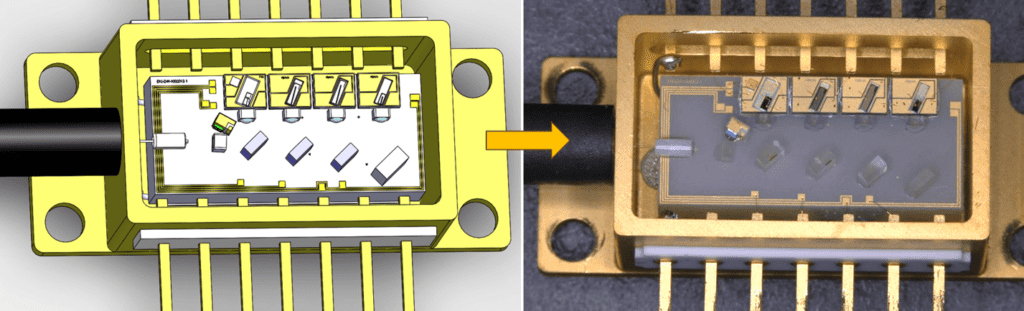
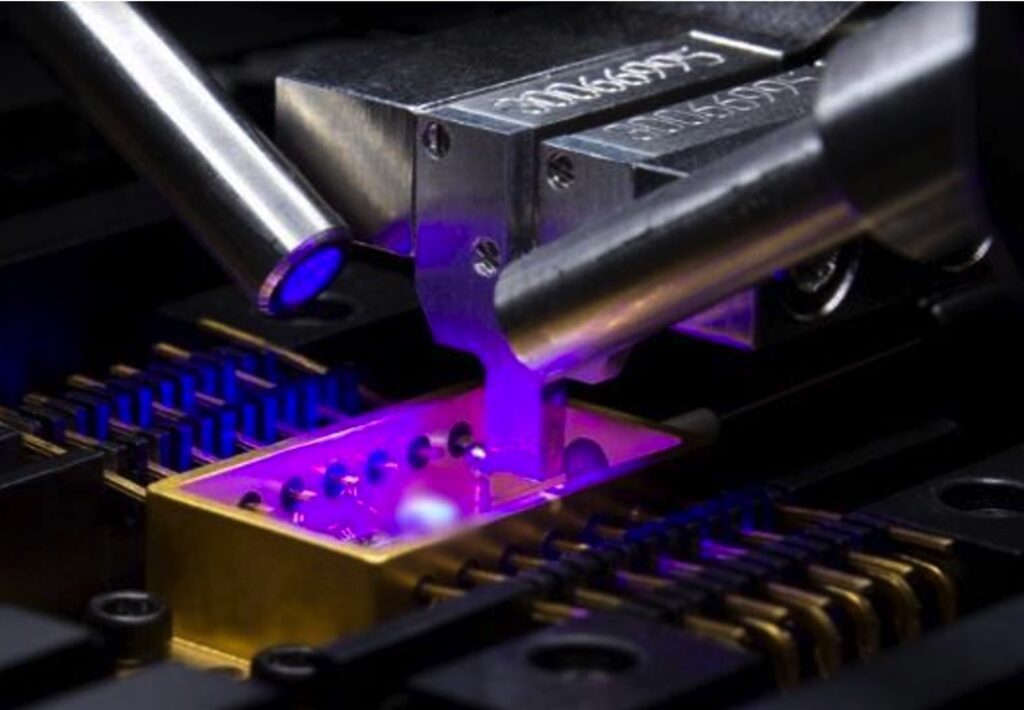
The EXALOS Hybrid Optical Packaging Platform (HOPP) is a packaging technology that has been developed and used since 2008 for realizing advanced optical modules with miniature components (millimeter-size or smaller) that are aligned and assembled with micron-level or even sub-micron precision. The bonding process is based on specialized UV-curable and thermally curable epoxies that feature ultra-low shrinkage, extremely high bonding and shear forces and NASA-compliant ultra-low outgasing suitable even for space applications.

Benefits of Micro-Optical Integration
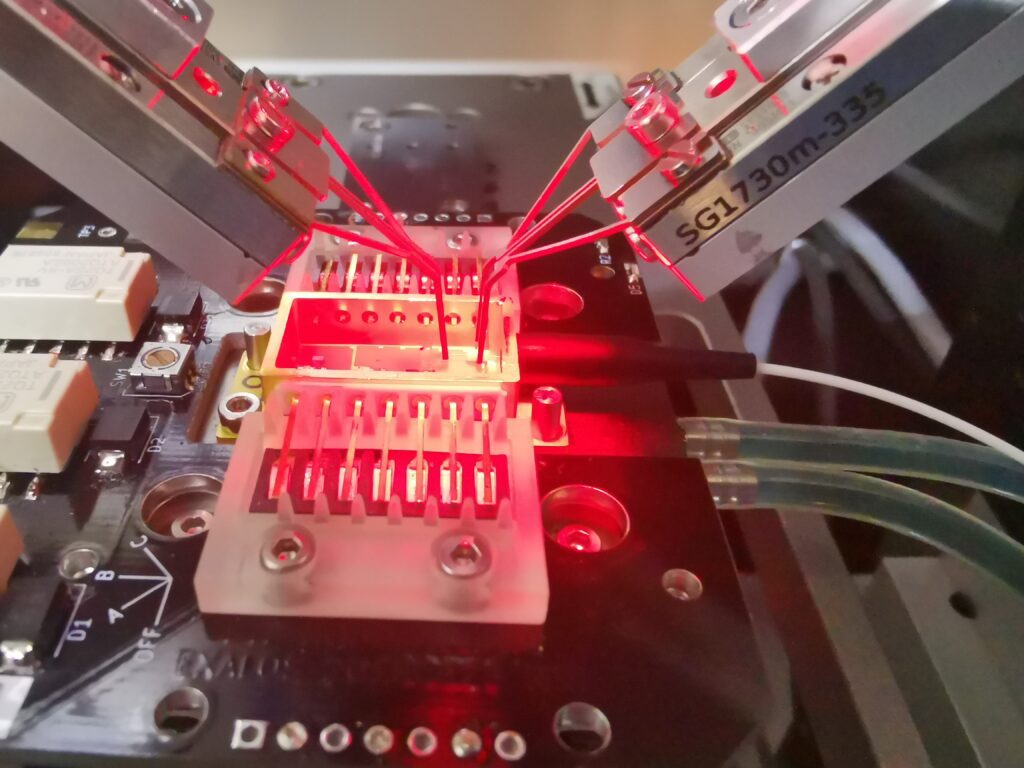
The micro-optical HOPP technology allows for realizing a high level of integration for ultra-compact and ultra-dense optical assemblies and modules with superior optical performance. The optical components can be either passively placed based on pre-defined coordinates with a typical precision of 50 microns and 0.05° (200 arcsec) or actively aligned using feedback signals and advanced alignment algorithms, achieving a typical precision 0.1 microns and 0.005° (20 arcsec).
The bond forces are extremely high with shear forces that are typically an order of magnitude higher than what is defined by MIL-Std-883E, resulting in rugged optical modules suitable for harsh environmental conditions that exceed standard Telcordia requirements. The advanced HOPP technology has been qualified according to standard G-468-CORE Telcordia and MIL-St-883 requirements and has demonstrated superior long-term reliability performance with mean-time-to-failure (MTTF) values of several 10k operating hours or more.
Automated Micro-Optical Assembly: From Prototyping to Volume-Production
The HOPP optical integration typically starts with a detailed optical modeling using advanced software and simulation tools that capture the free-space beam propagation, including collimation, diffraction, multi-path reflection and other effects, resulting in reliable estimates for fiber-coupling efficiency or residual stray light analysis. The outcome of the optical modeling is a detailed optical layout that is transferred to the automated alignment machine where a step-by-step build recipe is implemented for the optical module.
The HOPP technology allows not only for rapid prototyping but enables cost-efficient and high-volume manufacturing of optical modules. As the optical modules are built by robots using fully-automated and operator-independent alignment algorithms, excellent repeatability in assembling optical components is achieved, resulting in reduced variation of the optical module performance and thus in high yield and high throughput.