



Quantum Key Distribution (QKD) is a cryptographic primitive that lets two distant parties, conventionally called Alice and Bob, generate a shared string of random bits that only they know. Unlike public key algorithms whose security rests on unproven mathematical assumptions, QKD relies on fundamental quantum mechanical laws: any attempt by an eavesdropper (Eve) to observe the quantum states inevitably introduces a measurable disturbance, so Alice and Bob can detect and discard compromised key material.
Digital transformation programs in government, finance, healthcare and critical infrastructure are accelerating QKD deployment because of the “store‑now, decrypt‑later” risk posed by large scale quantum computers. By feeding one‑time‑pad keys or frequently rotated AES‑256 keys into existing equipment, QKD augments classical encryption without changing user traffic formats.
The earliest commercial systems followed prepare‑and‑measure protocols such as BB84 and decoy‑state BB84: Alice encodes each weak coherent pulse in one of two conjugate bases and Bob measures in a randomly chosen basis, later reconciling choices over an authenticated classical channel. In parallel, entanglement‑based approaches (E91, BBM92) distribute pairs of entangled photons; correlated detection events yield the raw key and can, in principle, be extended via quantum repeater technology.
Modern QKD technologies tackle scalability, side-channel immunity and range. Recent achievements include:
Measurement Device Independent QKD (MDI-QKD) removes all detector side-channels by interfering photons from Alice and Bob at an untrusted relay; a 2025 multi- user field trial using integrated optical frequency combs achieved ~267 bps per user pair over 30 dB channel loss1.
Twin Field QKD (TF-QKD) breaks the rate-loss limit for point-to-point links; laboratory experiments have surpassed 1 000 km of standard fiber with finite-key security proofs2.
Continuous-Variable QKD (CV-QKD) encodes information in the quadratures of coherent states and benefits from telecom grade, narrow-linewidth lasers.
Chip integrated QKD leverages silicon photonics: recent prototypes exceed 1 Mbps secure key rates over 100 km fibers at 2.5 GHz clock rates, and gigabit-per-second demonstrations have been reported in laboratory settings3.
Beyond fiber, satellite QKD projects in Europe, North America and Asia aim to deliver global key exchange; low-earth-orbit testbeds are already distributing keys to ground stations.
To foster interoperability and certification, the ETSI Industry Specification Group QKD (ISG- QKD) issued updated 2024–25 work items covering protocol security proofs, component characterization, REST-based key delivery APIs and reference network architectures. These specifications are guiding vendors and operators toward carrier-grade deployments4.
In summary, QKD has matured from laboratory demonstrations to an industrial technology stack that complements post-quantum cryptography, with rapidly advancing protocols (MDI, TF, CV), integrated photonics implementations, satellite extensions and an active standardization ecosystem—all aimed at delivering provable confidentiality for the decades of quantum computing that lie ahead.
Factor Limiting QKD Performance
Several factors limit the speed, range, and reliability of today’s quantum key distribution links. Fundamental physics limitations, detector limitations and constraints, protocol-level trade-offs, finite key and authentication overhead, and network topology all pose their own sets of limitations. Additional factors are influenced by optical components, where indie’s products can make an impact. We have identified three such areas.
1) Channel Induced Limitations
Fiber Attenuation
At 1 550 nm, standard single-mode fiber exhibits an attenuation of approximately 0.18–0.22 dB/km, which limits the loss budget to roughly 30 dB—equivalent to 150–170 km—for conventional BB84 links. Twin Field QKD (TF-QKD) extends the reach to beyond 1 000 km by allowing Alice and Bob to send phase correlated weak pulses to an intermediate node, but this gain is achieved at the cost of lower raw key rates and stringent phase stability requirements.
Chromatic and Polarization Mode Dispersion
Without active dispersion compensation, these effects degrade interferometric visibility at gigahertz class clock rates, directly reducing secure key throughput. indie’s Fiber Bragg Grating (FBG) line of products, shown in the next section, provides efficient chromatic dispersion compensation.
Background Optical Noise
Raman scattering from co-propagating DWDM channels—along with ambient daylight in free-space links—introduces excess noise that elevates the quantum-bit-error rate (QBER). Using a low phase noise laser source becomes critical in this condition, which indie’s LXM ultra-low noise laser provides.
2) Source-Side Imperfections
| Imperfection | Impact on Performance |
|---|---|
| Laser Linewidth And Phase Noise | TF-QKD and CV-QKD protocols require sub-kilohertz linewidths and tight phase-lock loops; residual phase drift lowers interference visibility and therefore the secure-key rate (SKR). Indie’s LXM ultra-low noise laser source has a linewidth of 0.08 kHz and is well suited for these applications. |
| Pulse To Pulse Intensity Correlations | Correlations undermine the assumptions of deco-state security proofs, forcing conservative privacy amplification that significantly reduces usable key output. |
| Modulator Extincting Ratio And Calibration Drift | Inadequate extinction or drift can leak basis information (state preparation flaws), raising QBER and eroding security margins. |
3) Environmental and System Integration Considerations
Thermal and Mechanical Perturbations
Temperature fluctuations and vibration induce changes in fiber birefringence and optical path length. Field deployed units, often multiplexed alongside dense WDM traffic, must therefore incorporate active stabilization or real-time feedback.
Component Insertion Loss
Passive elements such as fan-outs, planar lightwave circuit (PLC) chips, and polarization controllers each add fractions of a decibel; in aggregate, a multi-component chain can consume the entire link loss budget. indie’s FBG products, shown in the next section, compensate for dispersion with much less loss than dispersion-compensation fiber-based products.
indie’s Solutions for QKD
Over the years, indie has developed several qualified products and technologies that address current and future challenges of QKD systems manufacturers:

Low-Loss Dispersion Compensators
indie’s DCML addresses chromatic dispersion with full C-band coverage to improve QKD signals over long distances. With an insertion loss lower than 3 dB for distances up to 200km with a single module, these compensators also prevent intrachannel and interchannel nonlinear impairments and have negligible latency, enabling much longer QDK links.
High Precision Filters
Tunable and static filters advanced optical filtering solutions reduce the detrimental effect of non-linear scattering and other sources of optical noise in the QKD system. QKD using attenuated pulses typically requires passband filters with high spectral isolation and a bandwidth of about 2-20 GHz that is determined by the pulse repetition rate. Depending on the required bandwidth and other application challenges, a frequency tunable or an athermal package can be used to boost filter performance and stabilize its center wavelength. This is particularly critical when encoding quantum information in the frequency sidebands of an attenuated coherent state.


Ultranarrow Bandpass Filters
With bandwidth from 50 MHz to 500 MHz, indie’s ultra narrowband tunable optical filters are well suited to QKD systems using entangled photons source. For example, they can be used to optimize bandwidth following the spontaneous parametric down conversion process (SPDC).
Low Noise Lasers
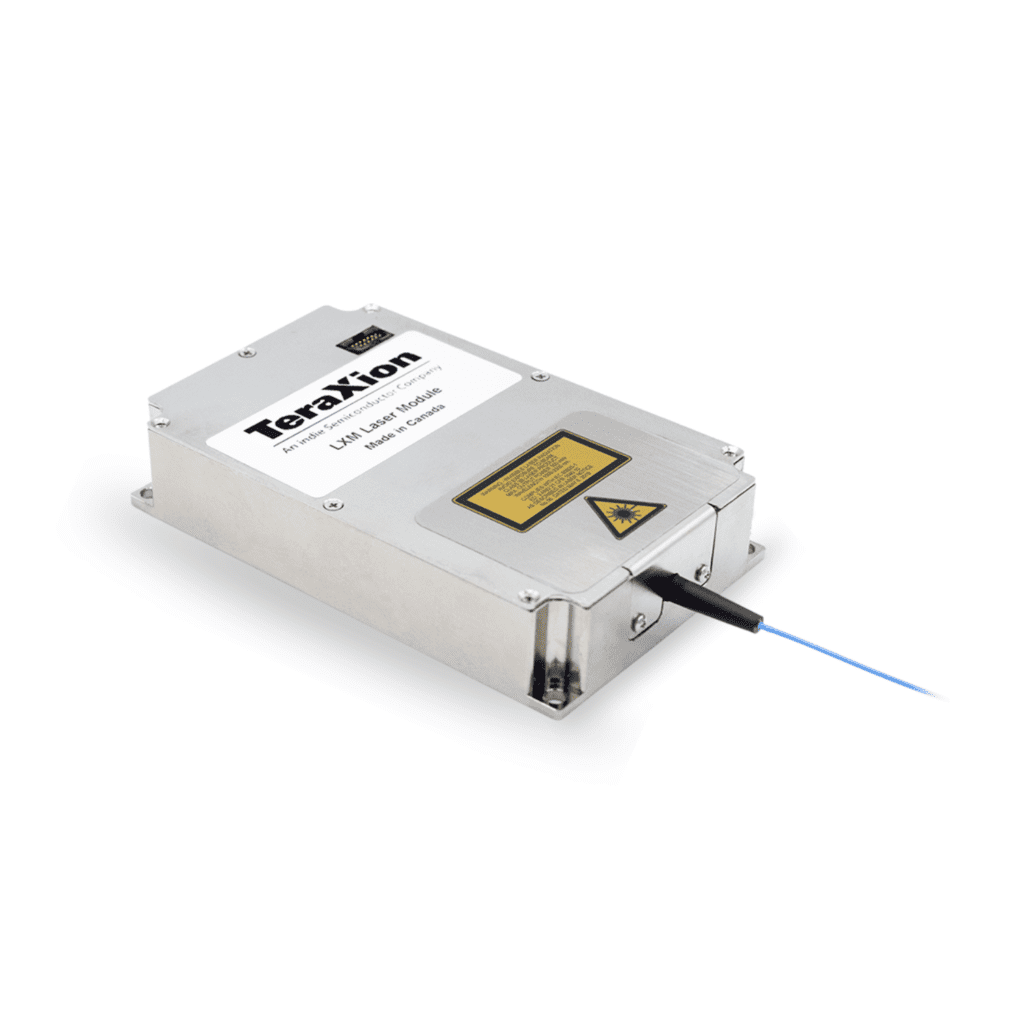
The LXM-U, the latest in indie’s portfolio of narrow-linewidth semiconductor lasers, is exceptionally suitable for quantum technologies—particularly in quantum key distribution (QKD) and quantum computing. With its ultra-low-frequency noise, 10x lower than competing technologies, and narrow-linewidth, the laser delivers the precision and stability required for the most demanding quantum applications. Its long term stability maintains a locked operation for days, enabling reliable transmission of cryptographic keys.
A unique differentiator of the LXM-U laser is the ease to co-package it with other lasers and Photonic Integrated Chips (PICs). This allows us to collaborate closely with our customers on the design, using their proprietary technology with our laser to manufacture light engines with optimized performance and cost efficiency.
Whether using single-photon sources, attenuated pulses, entangled photons, CV-QKD, twin field QKD, or a novel approach, our engineers are happy to discuss your system challenges.
Endnotes