



Distributed acoustic sensing (DAS) relies on the scattering of light in optical fibers to detect perturbations on the fiber itself along its length. Since the scattering signal is weak, efforts continue to be made to improve the sensitivity of DAS, as well as its spatial resolution and maximum sensing range. To that end, coherent detection methods are commonly used. These methods put strong requirements on the coherence length and stability of the laser source. Stable, narrow linewidth laser sources with low frequency noise are therefore necessary to improve DAS sensitivity while allowing detection over long ranges.
DAS has proven useful in a variety of applications such as perimeter detection, structural health monitoring, seismic monitoring, and more. Because it is immune to electromagnetic interferences, and because it can be implemented in existing fiber networks, its expansion to broader uses is inevitable. As such, the development of low-cost light sources with small footprints and excellent stability is essential. Here, we present the capabilities of indie’s LXM as a candidate for coherent DAS systems.

Distributed Acoustic Sensing Principles
As it travels through an optical fiber, light encounters defects such as stress points or inhomogeneities in the glass and undergoes Rayleigh scattering. Although most of the scattered light exits the fiber immediately, a small portion is re-captured and travels towards a detector which is typically installed at the fiber input. It is then possible to detect this Rayleigh scattering signal (Figure 1).

The waveform of the Rayleigh signal is linked to the distribution of the defects along the fiber. As such, the Rayleigh signal of any unperturbed fiber is unique and repeatable. However, any perturbation to the fiber, such as acoustic signals, may impact the Rayleigh signal. It is those deviations which are detected and interpreted through DAS. By then carefully matching the Rayleigh pattern to the time-of-flight along the fiber length, it is possible to assign a position to each perturbation.
DAS techniques can be divided in two broad categories, although several recent advances have relied on some combination of these techniques1,2,3. The first category is Optical Time-Domain Reflectometry (OTDR). A pulse is launched in the fiber and the resulting Rayleigh signal is continuously detected at the fiber input. The spatial resolution of such system is inversely proportional to the pulse duration. Because the pulses are short (typically tens to hundreds of nanoseconds) and since the pulse peak power must be limited to avoid undesirable nonlinear effects in the fiber, the Rayleigh signal obtained for any given position in the fiber is quite weak. Therefore, OTDR techniques benefit from coherent detection schemes to increase their sensitivity4.
The second category is Optical Frequency-Domain Reflectometry (OFDR). In this case, the light is not pulsed but rather frequency swept. The Rayleigh signal is coherently mixed with a local reference, and the resulting beat note is detected. Since the beat note frequency is proportional to the position of origin of the Rayleigh scattering signal, spatial information can be retrieved. A major advantage of OFDR is that the total energy launched in the fiber is much greater. Indeed, since the laser source is continuous rather than pulsed, a higher signal-to-noise ratio can be reached while avoiding issues of peak power.
In both cases, coherent detection methods require that the signal remains coherent with the local oscillator after its propagation over the fiber length and back. This puts restrictions on the maximum sensing range, which must be shorter than half of the coherent length of the laser source. The long coherence length offered by narrow linewidth lasers thus enables long-range DAS applications.
Furthermore, the detection of perturbations relies on comparative measurements between the real-time Rayleigh scattering signal and some previously acquired reference signal. Any slow frequency drift may affect the unperturbed Rayleigh scattering pattern and render the comparison unreliable, which results in a loss of signal-to-noise ratio and lower sensitivity of the DAS system. This puts a further requirement on the laser source; its frequency noise should be minimal at low Fourier frequencies.
For these reasons, laser sources that offer a low frequency noise and long coherence length, such as narrow linewidth lasers, are essential for DAS applications.
indie’s solutions for DAS
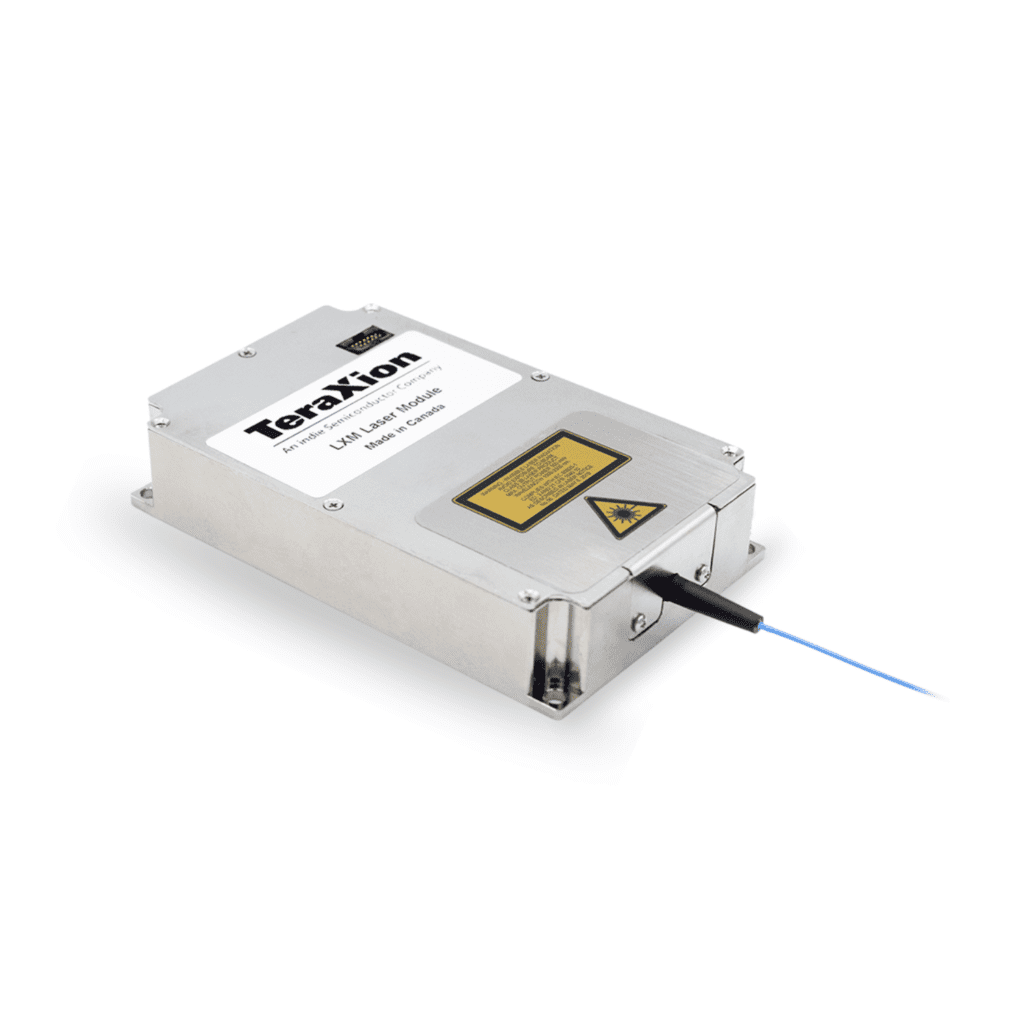
indie’s expertise with the design of distributed-feedback (DFB) laser diodes and frequency noise reduction electronics come together with the LXM-U, a cost-effective, narrow linewidth laser module. The LXM-U is the only laser that combines the low frequency noise traditionally associated with fiber lasers (Figure 2) with the low intensity noise inherent to semiconductor lasers (SCL) (Figure 3). In fact, the LXM-U exhibits a significantly lower frequency noise (by up to two orders of magnitude) compared to DFB fiber lasers in the DAS low-frequency region of interest (a typical DAS event’s frequency window, extending up to 50 kHz, is shaded in gray in Figure 2).


Unlike external cavity lasers, the optical mode stability of the LXM-U does not depend on a critical alignment between the gain medium and a resonator. The proven stability of DFB laser diodes is thus retained and the reduction in frequency noise is not done at the expense of stability. The small size of the diode also confers an advantage over the longer cavities of fiber lasers, which are known to be sensitive to mechanical disturbances (Figure 4).

Owing to its robustness, mechanical stability and a typical instantaneous linewidth below 0.08 kHz5, the LXM-U is well suited for high-sensitivity, long-range coherent DAS applications. Also available is the LXM-S, a free running version of the LXM without frequency noise reduction and therefore ideal for lower-range DAS applications. For OFDR applications, better spatial resolutions are achieved with larger frequency sweeps of the modulated laser source. The free-running LXM-S offers frequency sweeps up to 8 GHz6, making it well-suited for lower-range, higher-resolution OFDR. Meanwhile, the 200 MHzfrequency sweeps capability of the frequency-locked LXM-U is compatible with long-range OFDR architecture, which shows promise for applications such as submarine cable monitoring, for instance7. In summary, LXM solutions provide significant flexibility in sweep rates and amplitude, enabling their adaptation to a wide range of applications.
In OFDR, another important parameter is that the frequency sweep of the laser source must be linear in time, such that the frequency of the beat note between the local reference and the return signal remain strictly proportional to the travel time of the latter. Any deviation from this linear relationship induces a loss in sensitivity and range precision8. The ultra-flat frequency-modulation response of the LXM modules allow to reach high linearities in a variety of modulation patterns. For example, we demonstrated 8 GHz frequency chirp at a 10 kHz modulation rate and less than 0.01% non-linearity with an LXM-S (Figure 5), which allows to develop OFDR DAS architectures with submeter spatial resolution.

Figure 6 shows a quick demonstration that was achieved within indie’s laboratory using equipment typically used in Frequency-Modulated Continuous Wave (FMCW) lidar research9. This demonstration was achieved with highly linear 1 GHz sweeps at a 100 kHz repetition rate.

Conclusion
Narrow linewidth lasers modules enable high-performance, coherent DAS systems with heightened sensitivity and longer spatial ranges. To support the ongoing advancements in DAS technologies, the LXM provides a stable, robust, and compact laser module specifically designed for industrial deployment. Compared to fiber lasers, the frequency-locked LXM-U offers a lower PSDFN at low Fourier frequencies, where DAS systems are particularly susceptible to frequency noise. Furthermore, its performances are less affected by mechanical perturbations. For applications such as optical frequency-domain reflectometry, LXM solutions also offer strongly linear frequency sweeps. These solutions offer significant flexibility in terms of sweep rates and amplitudes, enabling precise adaptation to a variety of use cases. Such availability of stable, narrow linewidth lasers should not be underestimated as a driver for the development of next generations DAS technologies.
Related Products
| Products | |
|---|---|
| Ultra-Narrow DFB Laser Module – LXM | View product |
| C-Band Distributed Feedback Laser Diode – LXC | View product |
- Muanenda Y., Recent Advances in Distributed Acoustic Sensing Based on Phase-Sensitive Optical Time Domain Reflectometry. J. Sens., 2018, vol. 2018, pp. 1-16 ↩︎
- Rao Y, Wang Z, Wu H, Ran Z and Han B., Recent Advances in Phase-Sensitive Optical Time Domain Reflectometry (Ф-OTDR). Photonic Sens., 2021, vol. 11, no. 1, pp. 1-30 ↩︎
- Ding Z, et al., Distributed Optical Fiber Sensors Based on Optical Frequency Domain Reflectometry: A review. Sensors, 2018, vol. 18, no. 4, p. 1072 ↩︎
- Muanenda Y., Recent Advances in Distributed Acoustic Sensing Based on Phase-Sensitive Optical Time Domain Reflectometry. J. Sens., 2018, vol. 2018, pp. 1-16 ↩︎
- Lorentzian instantaneous linewidth obtained by multiplying the one-sided PSD of frequency noise measured at 1 MHz by π. ↩︎
- The standard LXM-S configuration is specified at 4 GHz typical amplitude for 10 kHz modulation rate, but extended modulation amplitude is available under request ↩︎
- Mazur M, et al., Advanced Distributed Submarine Cable Monitoring and Environmental Sensing using Constant Power Probe Signals and Coherent Detection. arXiv:2303.06528v1 [eess.SP] ↩︎
- Liang C, Bai Q, Yan M, Wang Y, Zhang H, and Jin B., A Comprehensive Study of Optical Frequency Domain Reflectometry., IEEE Access, 2021, vol. 9, pp. 41647–41668 ↩︎
- Cardin V, et al., Narrow-linewidth semiconductor laser with highly-linear frequency modulation response for coherent sensing. Proc. SPIE 12905, Novel In-Plane Semiconductor Lasers XXIII, 129050F (2024) ↩︎