




Customer Background
Dr. Kayvan Forouhesh Tehrani is an experienced biophotonics engineer specializing in microscopy and bioimaging and is the founder and CEO of Eleuthra Photonics. Eleuthra Photonics specializes in developing and producing rapid image-based diagnostic tools for analyzing tissue and cell samples, with a primary focus on cancer and other disease diagnoses. Eleuthra’s Tetraquant™ platform provides multimodal nonlinear imaging technology through the use of a single femtosecond excitation laser.
The Challenge
Nonlinear Optical Label-Free Imaging (NOLFI) presents several technical and practical challenges that must be addressed for successful integration into clinical digital histopathology workflows. One key limitation is signal weakness, as nonlinear processes inherently produce low-intensity signals, requiring either extended acquisition times or increased laser power—both of which elevate the risk of photodamage. Achieving high-resolution, high–signal-to-noise-ratio imaging, without photodamage demands carefully tailored excitation spectra and pulse parameters. Standardization across platforms is another challenge, affecting reproducibility and hindering regulatory approval. Finally, conventional lasers are often bulky and not easily integrated into compact platforms. Addressing these limitations is essential to fully realize the transformative potential of NOLFI in digital histopathology.
The Solution
To overcome the limitations of traditional nonlinear imaging systems, Eleuthra Photonics integrated the VINCI-1064 femtosecond fiber laser into its multimodal imaging platform. The VINCI-1064 was selected for its unique combination of high peak power, broad emission spectrum, and cost effectiveness, making it well suited for clinical and research environments alike. Its ability to generate ultrashort, high-intensity pulses significantly enhances nonlinear conversion efficiency, enabling a stronger signal generation at lower power levels—thereby reducing the risk of photodamage. The laser’s low-noise characteristics further contribute to superior image quality and signal-to-noise ratio, which is critical for accurate tissue visualization. Additionally, the compact and robust design of the VINCI-1064 supports seamless integration into the imaging platform, minimizing footprint and lowering overall system complexity and cost. This integration represents a critical advancement toward scalable, high-performance NOLFI systems suitable for digital histopathology.
The Results
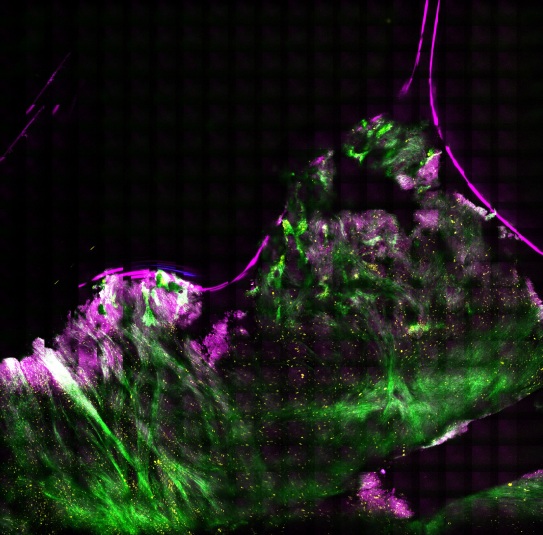
The integration of the VINCI-1064 femtosecond fiber laser has enabled Eleuthra Photonics to develop a compact and portable nonlinear imaging system without compromising performance. Leveraging VINCI’s high peak power, low-noise output, and compact form factor, the platform delivers high-quality, label-free imaging with enhanced signal-to-noise ratio — all within a footprint suitable for clinical and point-of-care settings. This marks a significant step toward the practical deployment of advanced digital histopathology technologies.
“Integrating the VINCI-1064 laser into our imaging platform was a smooth and efficient process, thanks to both the laser’s intuitive design and the outstanding support from the indie team. Their technical expertise and responsiveness made the transition seamless, allowing us to accelerate development timelines without interruption.” — Dr. Tehrani, Founder and CEO, Eleuthra Photonics
Conclusion
The successful integration of the VINCI-1064 femtosecond fiber laser into Eleuthra Photonics’ Tetraquant™ platform demonstrates how advanced laser technology can address longstanding challenges in nonlinear optical label-free imaging. By delivering high peak power with low-noise in a compact form, the VINCI-1064 has empowered Eleuthra Photonics to build a portable, high-performance imaging system capable of producing clinically relevant, high signal-to-noise ratio images without photodamage. This collaboration underscores the critical role of innovative laser solutions in advancing the field of digital histopathology and brings the vision of real time, label-free tissue diagnostics in clinical settings significantly closer to reality.
What Is Digital Histopathology?
Histopathology is a diagnostic discipline founded on the visual interpretation of cellular biology captured in images using a microscope. The advent of digitized images to pathology has propelled this traditional field into what is now described as digital pathology. This approach is often used in cancer diagnostics to help detect disease markers.
indie’s ultrashort pulse laser can be used in Nonlinear Optical Label-Free Imaging (NOLFI), an emerging imaging method in digital histopathology that enables:
- Reduced risk of photodamage by generating stronger signals at lower power levels.
- Superior image quality for enhanced tissue visualization, thanks to a low-noise design.
- Seamless integration into imaging platforms, minimizing system footprint.
Related Product
| Product | |
|---|---|
| Femtosecond Laser – VINCI-1064 | View product |