




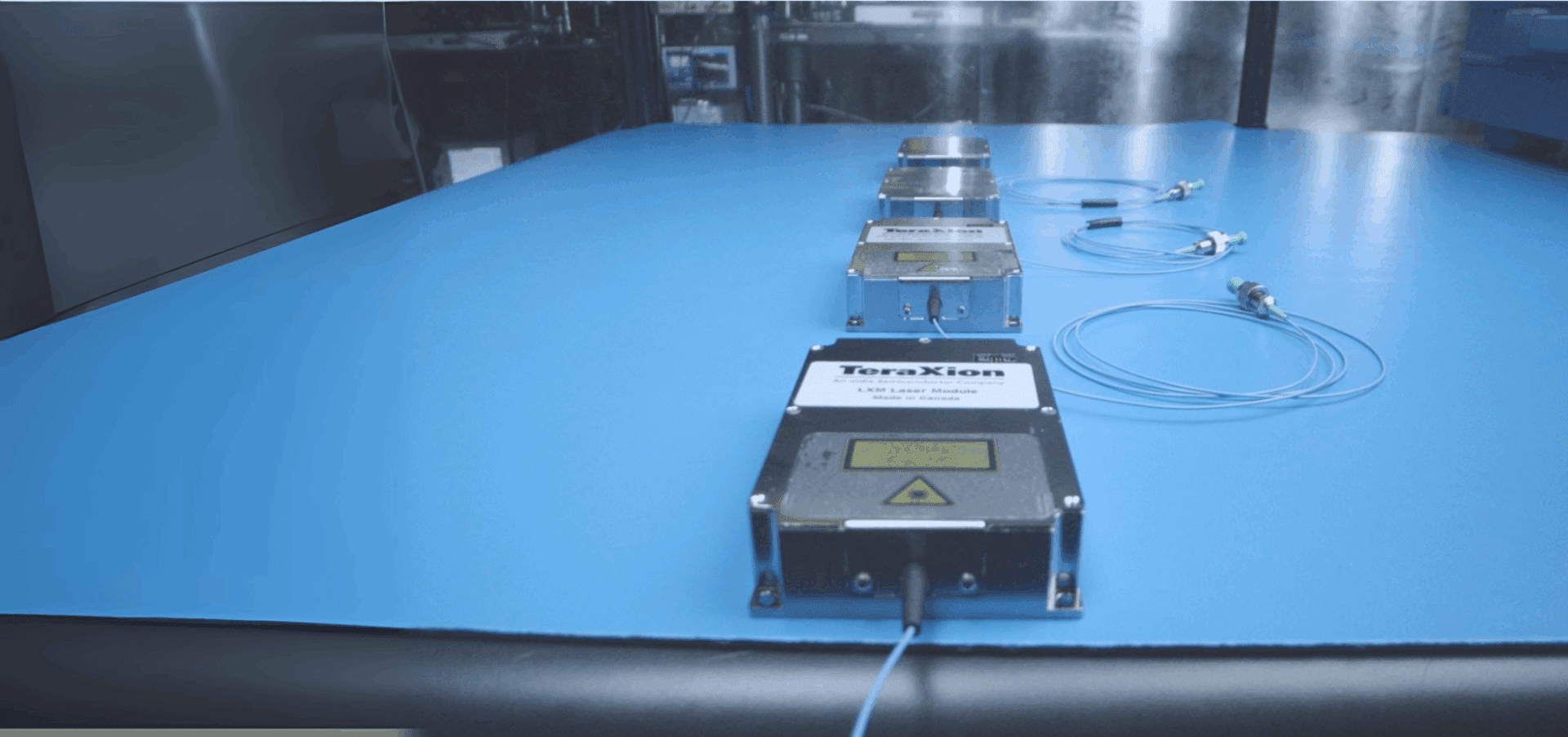
With the turnkey 100% solid-state LXM laser, indie introduces a key building block for seamless integration in sensing applications requiring low frequency noise and precise frequency tuning at a high sampling rate.
The LXM sets a new standard for enhanced detection by delivering low noise, high optical power, and a narrow-linewidthhallmarks of superior laser sources and essential elements for successful applications. The LXM-S features a typical linewidth of 15 kHz, while the LXM-U incorporates a frequency locking loop that reduces the linewidth to a typical value of just 0.08 kHz.
At the heart of the LXM, indie’s proprietary distributed feedback (DFB) semiconductor laser delivers a flat frequency modulation (FM) response in both magnitude and phase. This application note explains how the flat FM response enables exceptional performance in applications with demanding modulation requirements, including frequency-modulated continuous wave (FMCW) LiDAR, optical frequency-domain reflectometry (OFDR) distributed fiber sensing, and distributed acoustic sensing (DAS).
Quick Note on the Notion of Frequency Modulation (FM)
- The FM response of a laser defines how its optical frequency is shifted under an external modulation.
- The FM response is quantified by both a magnitude and a phase delay. A high magnitude enables large optical frequency shift. A flat phase delay enables low-distortion modulation, and high-bandwidth locking loops.
The LXM module is designed such that the current driving its DFB laser diode can be modulated at high speeds. Varying the current applied to a semiconductor laser leads to a change in the effective index of refraction and temperature of the semiconductor material composing its cavity11. These changes lead to a shift in the optical frequency of light emitted by the laser. Typically, this modulation in driving current is a relatively weak AC component added to the much stronger DC current feeding the population inversion.
The relationship between this modulation of the drive current of a semiconductor laser and the ensuing modulation of the optical frequency of the output laser beam is called the frequency modulation (FM) response of the laser. The FM response is characterized by both a magnitude [in MHz/mA], and a phase delay [in degrees, or radians] spectra. It is equivalent to the transfer function linking the waveform of the incoming current modulation to the waveform of the correspondingly modulated optical frequency.
A flat FM response means that the optical frequency of the laser light linearly follows the modulation current waveform. On the other hand, non-uniformities in the FM response of the laser can lead to unwanted distortions of the optical frequency of the output light.
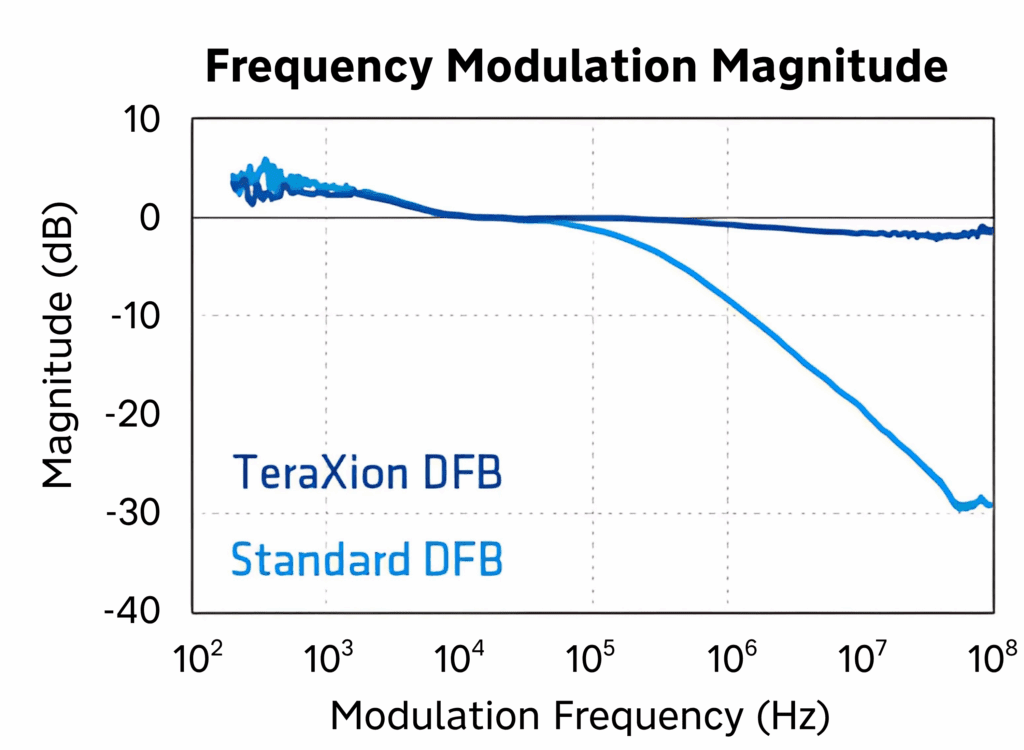
Through a carefully crafted balance between thermal and charge carrier effects, the intrinsic characteristics of indie’s DFB laser diode are optimized such that it achieves a flat magnitude and phase response up to the highest frequency bandwidth.
The Figure 1 compares the FM response of the LXM series DFB laser diode with a typical DFB laser diode.

LXM-S: Simple solution for Demanding
Sensing and Communication Applications
- The LXM-S is the free-running version of indie’s LXM narrow-linewidth laser line.
- It integrates a DFB with an intrinsically flat and high bandwidth FM response (magnitude and phase).
- It offers several MHz frequency modulation speed and a frequency excursion up to 4 GHz-pp standard with an 8 GHz-pp option available.
- This makes it an ideal laser source for frequency sweeping sensing applications such as FMCW LiDAR, and OFDR distributed fiber sensing, that also demand high wavelength stability and narrow-linewidth.
While some applications benefit from the ultra-narrow linewidth of the LXM-U’s locking loop, others can take advantage of the free-running LXM-S. Below are two examples demonstrating how the LXM-S’s unique modulation capabilities make it an ideal choice for fiber and remote sensing applications.
FMCW LiDAR takes full advantage of the LXM-S FM response
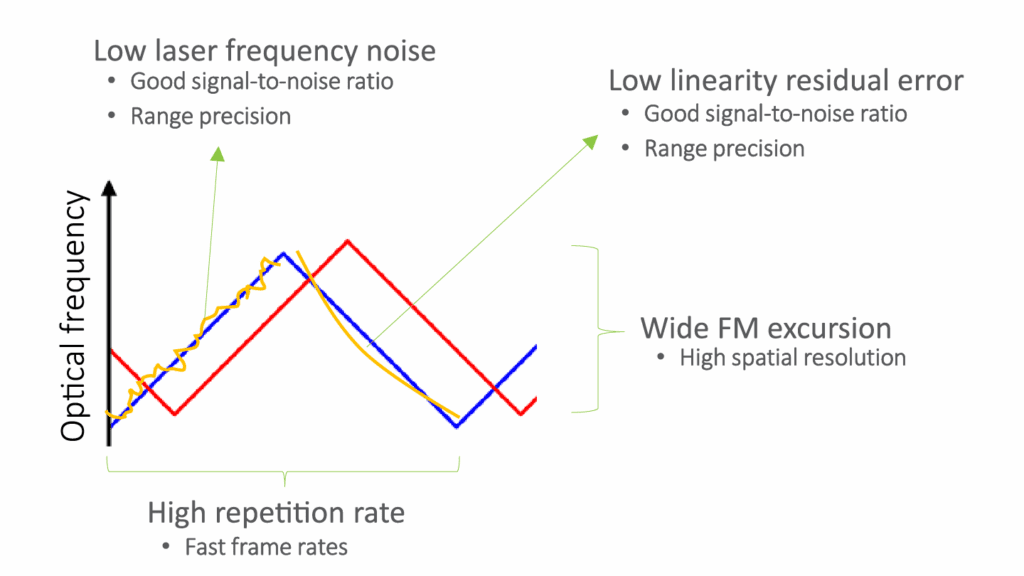
The LXM’s high frequency modulation bandwidth can be used effectively in FMCW sensing applications. Figure 2 shows the typical modulation scheme for this measurement. The triangular frequency ramps must be very linear as the precision of the measurements relies on the beat note measurements. A more linear ramp leads to better defined beat notes.

FMCW LiDAR takes full advantage of the LXM-S FM response.
1. Intrinsic linearity: A triangle wave is composed of odd harmonics of the repetition rate. The flat FM response of the LXM-S leads to low intrinsic harmonic distortions well into the MHz. For a 100 kHz triangle wave, this means that more than 50 harmonics can be reproduced in the optical output with little to no distortions, more than enough to reproduce a proper triangle waveform. This is another way of saying that the laser will show a high intrinsic linearity. At 100 kHz, the LXM-S provides typically less than 1% non-linearity compared to more than 10% for a conventional DFB.
2. Simple precompensation of the modulation waveform: Excellent repeatability of emitted frequency
vs. drive current is important for non-linearity compensation at the current level. For applications in which 1% non-linearity is too high, the input waveform can be pre-distorted to increase the linearity of the output optical frequency.
This is achieved by applying a correction function, iteratively determined, to the input waveform. This correction waveform may involve high amplitude, high frequency components, which the laser needs to be able to react properly to. Thus, the FM response of the laser can limit the maximum linearity achieved through pre-compensation of the waveform.
Figure 3 shows the effect of controlling the drive current in the LXM-S to achieve the best linearity, with a non-linearity below 0.1% for a ramp of 2 GHz at a 100 kHz repetition rate.
Figure 4 achieves a non-linearity below 0.04% for a ramp of 7.5 GHz at a 10 kHz repetition rate.


Note that in this application, the distance and longitudinal speed measured are both affected by the RIN and PSDFN of the laser source. PSDFN will limit the minimum measurable distance. With the LXM-S, one gets the benefit of low intensity noise, low frequency noise, and a high fidelity, high modulation bandwidth
Distributed Acoustic Sensing (DAS) in the Frequency Domain
Another application that requires all the LXM performance is distributed acoustic sensing (DAS). DAS based on coherent optical time-domain reflectometry (C-OTDR) can be limited in SNR when there is a limit to the peak optical power one can launch within a fiber. OFDR circumvent this limitation by coding the timing information in the frequency of a continuous wave light source. Using a CW source increases the average power one can use, while keeping the peak power minimal. Moreover, C-OTDR spatial resolution is limited to a few meters by the pulse duration, while OFDR can achieve centimeter or even millimeter resolution.
Most DAS schemes are based on Rayleigh backscattering (RBS). In static conditions, the RBS varies along a fiber due to manufacturing imperfections. Dynamically, it is sensitive to changes in environmental conditions, such as acoustic vibrations, temperature, fiber compression and other stresses. These cause local changes in the RBS. The reflectometry signal thus varies when such stresses occur and can be detected by comparison with a reference measurement. A low-noise, stable reference combined with an accurate measurement are necessary to achieve high detection sensitivity over a long distance. Frequency modulation amplitude, repeatability, linearity, and noise levels are thus critical.
The LXM-S exhibits high modulation amplitude at high speed which makes it an ideal source for OFDR DAS. In most frequency-sweeping sensing applications, the spatial resolution is limited by the amplitude of the frequency modulation. Sweeping a large frequency span is needed to get the accurate location of the perturbation being monitored. However, acoustic frequencies extend well into the kHz range, much too fast for frequency sweeping based on thermal effects. At 10 kHz, through direct modulation, the LXM-S can still achieve frequency amplitude of 8GHzp-p.
One example of DAS application is perimeter security. A fiber is deployed along a monitored perimeter. Intrusion attempt (e.g., fence climbing, tunnel digging, etc.) causes disturbances in the RBS, measured continuously. Figure 5 shows an example of an OFDR based DAS measurement using the LXM-S. The 2D map shows the full measurement with Fourier transforms giving the location and frequency of the detected vibration.

A 100% Solid-state DFB Laser Designed for Improved Frequency Locking
- A well-behaved phase response is required to achieve a stable frequency locking.
- The bandwidth of a frequency locking loop is often limited by the FM response of the laser being locked.
The linewidth of a laser is determined by its frequency noise. At low frequencies, technical noise is the dominating contributor, and decays at a rate of 1/f, down to a white noise limit. This constant noise floor is defined mostly by the spontaneous emission within the laser cavity2.
The technical noise and the spontaneous emission within a short cavity laser driven by high currents can be understandably high, widening the spectral lineshape. For a free-running laser, this larger linewidth can lead to high measurement uncertainties in any application sensitive to instantaneous frequencies or phase shifts. The indie DFB laser diode, with a typical value of 15 kHz, has the lowest intrinsic linewidth in its category.
These limitations of standalone DFB laser diodes can be circumvented using a frequency discriminator in a closed feedback loop with the laser. Frequency discriminators are optical elements that convert any shift in optical frequency to an easily detectable shift in light intensity, providing an error signal. Inverted, this error signal can be fed back to the laser to correct its noise-limited instantaneous frequency. Discriminators can be engineered so that their technical and white noise are naturally much lower than that of the laser. With proper locking hardware, one can achieve significant improvements in frequency noise, and thus linewidth.
The error signals described above can present very high frequency components. For the locking loop to be effective, the laser must be able to closely follow the corresponding correction signal up to these high frequencies, both in magnitude and phase. A severely delayed phase would not allow the correction signal to compensate the frequency noise that generated its error signal in the first place, leading to unstable loops.
With its flat FM response in the 10s of MHz range, the LXM allows the user to achieve stable, high gain, and high bandwidth locking loops. The correction signal from any external discriminator-based feedback loop can be fed back to the laser directly through the LXM SMA modulation port.
Conclusion
The LXM-S sets a new benchmark for high-performance laser modulation in sensing and communication applications. Its intrinsically flat and wideband frequency modulation (FM) response enables precise, low-distortion, high-speed tuning, critical for applications like FMCW LiDAR and OFDR-based distributed acoustic sensing (DAS). Whether used in free-running mode or combined with external frequency locking loops, the LXM-S delivers high modulation linearity and large frequency sweeps without sacrificing stability or speed.
In both the LXM-S and the locked LXM-U variants, users benefit from ultra-low relative intensity noise (RIN) and low-frequency noise, essential for improving sensitivity and measurement accuracy in demanding environments. Combined with a turnkey, fully solid-state architecture, the LXM series offers a reliable, drop-in solution for next-generation optical systems.
Related Product
| Product | |
|---|---|
| Narrow DFB Laser Module – LXM | View product |