




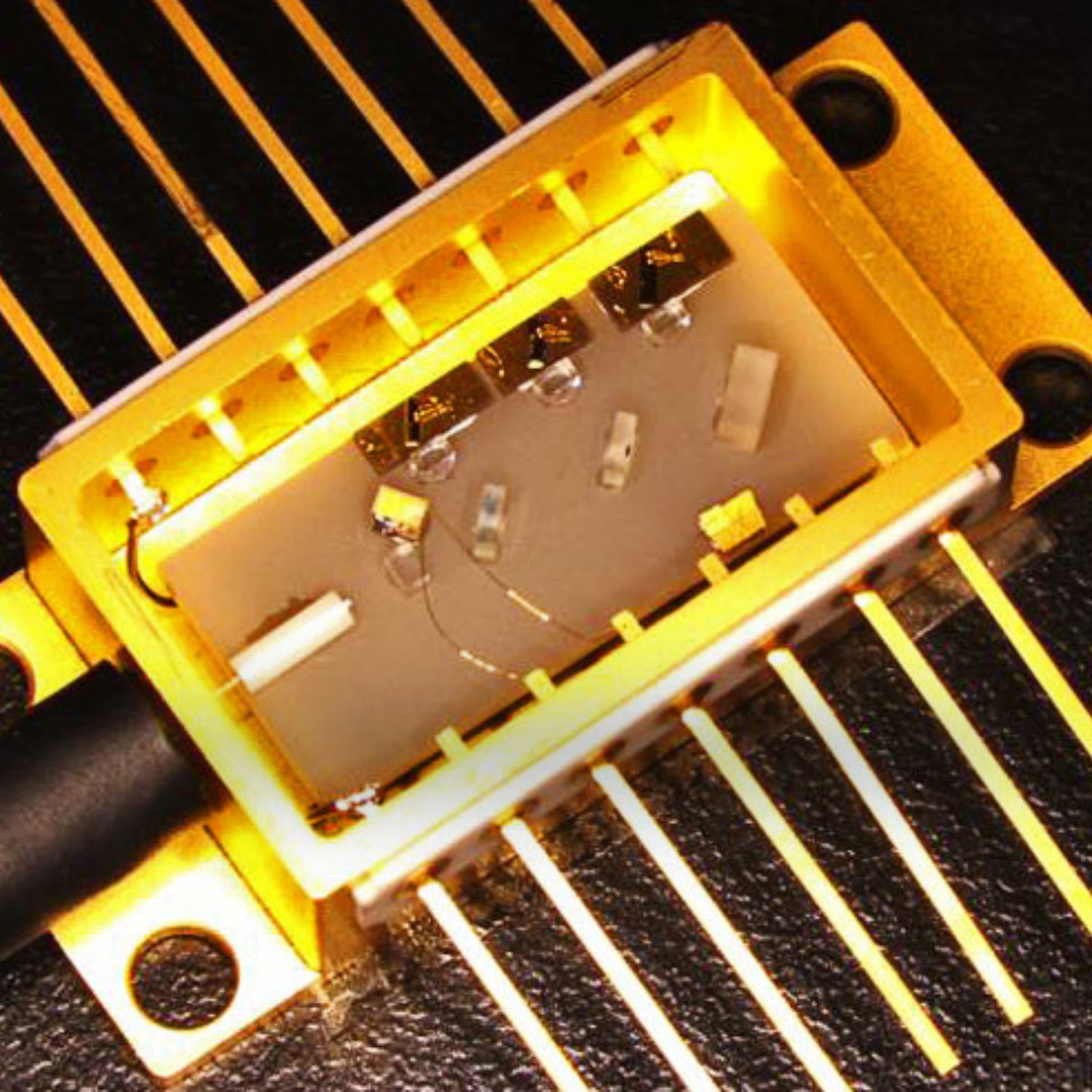
In a joint presentation by indie (former EXALOS) and customer FIBER OPTICAL SOLUTIONS (FOS) at the 61th DGON ISA symposium, experts from both companies demonstrated a novel integrated 1550 nm 3-fiber SLED transceiver module and its application in a high-precision Inertial Measurement Unit (IMU) for navigation.
The symposium took place in Brunswick (Braunschweig), Germany at October 22-23, 2024, as a face-to-face event.


indie’s (former EXALOS) developer Stefan Gloor presented the new integrated SLED Transceiver Optical Module.
The advanced device is realized with a micro-optical, free-space bench technology. All SLED light sources, all optical components as well as the three receiver photodiodes are assembled on a temperature-stabilized ceramic optical bench that is mounted onto a high-performance Peltier cooler (TEC).
The broadband SLED emits an optical spectrum with 3dB bandwidth of 33 nm around a center wavelength of 1549 nm. The output is collimated into three output beams that are propagating through an optical circulator before being focused into an array of three PM output fibers. Efficient beam collimation and low-loss beam propagation on the optical bench in combination with high-efficiency coupling to the PM output fibers results in output power values of around 1.0 mW per fiber channel at low drive currents of only 150 mA.
Higher output power values are obtained at higher SLED drive currents. The polarization extinction ratio (PER) of each fiber port provides more than 15 dB.
Three integrated receiver photodiodes detect the returned light from the PM fiber loop of the corresponding FOG. The design provides low transmission loss as well as high isolation and, therefore, high wavelength and power stability against backward-propagating light. Low optical crosstalk values of around -30 dB and low offset currents due to residual stray light inside the BTF module allow for the detection of low-power signals with high signal-to-noise ratio (SNR).
All in all, the low-loss optical architecture in forward and backward direction offers power-efficient operation with low SLED drive currents and thus low TEC currents over the full temperature range from -40°C to +85°C.
Yuri Korkishko, CEO Fiber Optical Solutions, presented a series of new single-axis fiber optic gyroscopes (FOGs) and inertial measurement units (IMUs) for navigation systems. The new units were built on the basis of the novel integrated EXALOS SLED transceiver module.
The application of the new innovative EXALOS 3-fiber transceiver design, provides a major simplification of the IMU architecture and the manufacturing processes.
The New IMU Architecture

The popular IMU requires a wide range of discrete optical components, including depolarizers, fiber splitters or fiber-pigtailed photodiodes, as well as eleven splices of polarization-maintaining (PM) fibers.

The innovative IMU design is based on the new integrated EXALOS SLED transceiver module. The 14-pin Butterfly (BTF) module delivers broadband light with similar optical power levels and with a high polarization extinction ratio (PER) at three PM output fibers. This allows the direct splicing to the three phase modulators (MIOC), reducing the number of PM fiber splices to only three.
Thanks to the micro-optical integration of the three closed-loop FOGs in the 14-pin BTF module the number of external components and finally the IMU footprint is significantly reduced.
The joint presentation, which was received with great interest, took place on Wednesday, 23-Oct-24.
Both companies looking forward to further successful cooperation in the development of innovative, market-leading products.
More about Fiber Optical Solutions Ltd., Riga, Latvia.
More about DGON ISA
The event works as a platform for connecting experts, researchers and applicants of inertial technology covering the full range from sensor development via application development up to integration into products and services.