


By Samuel Gouin, Product Line Manager – FBG Components, indie’s Photonics BU
The market for ultrafast lasers has seen tremendous changes in the last 10 to 15 years. Back then, only a couple of companies were able to offer the required specs for pulse duration, energy and quality required for industrial or medical (e.g. ophthalmology) applications. Nowadays, many suppliers are able to provide reliable lasers with competitive specifications, pricing and lots of differentiation features that can give them an advantage. Plus, the conventional specs of pulse duration, energy and power are more demanding than they were back then.
For the end users of ultrafast lasers, the offer is getting more interesting every year. It is now possible to choose systems that are meeting the application requirements at a competitive price. For the laser makers, this is both a blessing and a curse. Access to easy to use, reliable and affordable chirped pulse amplification (CPA) systems make their adoption possible for much more use cases, driving the demand and increasing market size for ultrafast lasers. The downside is that there is now much more competition, and keeping a competitive edge in performance and price is an even more challenging task than before.
How to navigate this new situation with more opportunities, but more threats
One of our customers, which will remain unnamed, is facing these challenges: how to improve the laser specifications while keeping the cost minimal. At the start of their project, their chirped pulse amplification (CPA) laser system was limited in pulse energy by the pulse quality, as shown in Figure 1.

Figure 1. Side lobes can be seen around the main pulse in the autocorrelation measurement when increasing the power.
Employing indie’s High stretcher quality grade, the TuneStretch-High (TPSR-H), the non-linear effects in the amplification chain were inducing side pulses when increasing the pulse energy, which was preventing our customer from extracting the available power and energy from their system, reducing the product’s cost efficiency.
For this text, the chosen figure of merit for pulse quality is the ratio of energy in the main peak over the total energy. At nominal pulse energy, the energy in the main peak ratio is 87.8% and falls to 75.1% at 2x the nominal energy. This degradation is of course not acceptable for most application, thus pulse energy must be limited.
Strategies like increasing the pulse stretching factor and/or changing amplifier type can help to tackle this issue as they will reduce non-linear effects, but they all require a significant redesign of the CPA platform, which can be quite costly to implement and will have drawbacks on other requirements like footprint and electrical power draw, to name only a few.
As the market leader of CFBG pulse stretchers, indie has observed this increasing strain on lasers engineers of all ultrafast laser companies to come up with cost effective solutions to improve system performance. indie also witnessed firsthand the growing pain of manufacturing lasers at the limit of the acceptable performance, which makes assembling the lasers arduous and time consuming. Because of the inherent complexity of CPA systems, the tolerance variations from all the components will make the end result unpredictable and require a lot of adjustment and cross correlation over different components to get to the correct specs. Expensive and frustrating.
A new way to navigate this evolving market
It was already clear years ago that the non-linear effects, predominantly through self-phase modulation (SPM), are more prejudicial to the pulse quality when the laser pulses have more phase ripples, and that reducing those ripples would increase pulse quality.
Leveraging 25 years of experience in designing and manufacturing high-end FBGs, our team of experts developed new methods to significantly improve the quality of CFBG stretchers, creating a new quality grade: the Ultra. The improvement is double: reducing the phase ripples and improving the precision of the reflectivity profile.

Figure 2. The new Ultra quality grade has both lower phase ripples and higher reflectivity profile precision than other quality grades.
With SPM, spectral ripples will induce temporal phase ripples, which in turn will increase spectral phase ripples in a vicious circle. This means that reducing the ripples over both the reflectivity and the phase of the pulse is key to reducing the impact of SPM over pulse quality.
Using an identical system to the one used to produce the results of Figure 1, our customer tested the new PulseStretch-Ultra (TPSR-U), allowing for an experimental comparison between the High and the Ultra quality grades. It is worth noting that because the difference between the TPSR-H and TPSR-U lies in the quality of inscription of the CFBGs, they can be interchanged directly, without the need for any adaptation to the system. A true drop-in replacement.
Figure 3 shows the autocorrelation measurements of the laser pulses obtained with the TuneStretch-Ultra. From these real-world results, it is obvious that the pulse quality is much improved with the TPSR-U, and that it remains better even at 2x the nominal pulse energy.

Figure 3. The TPSR-U allows to increase pulse quality at higher pulse energy when compared to the TPSR-H.
Using the pulse quality metric defined earlier, the energy in the main peak over the total energy ratio, Figure 4 can be plotted, where the resilience to high SPM levels can be easily read.

Figure 4. Measurements shows that the TPSR-U allows to double the pulse energy, while retaining pulse quality.
Of course, everyone is limited for the bill of materials (BOM) cost of the systems, and most people cannot afford to increase the cost of their laser . But a distinction should be made between the cost of the laser and its BOM.
While increasing the energy and pulse quality directly increases the value of the CPA laser, tightening the tolerancing on a critical component will make the laser assembly process smoother and more predictable. This is how a small increase in the BOM cost can reduce the laser system cost, by reducing the assembly cost. And since every ultrafast laser company needs to be at the limit of their performance to survive, the likelihood of this situation happening is very high.
Enabling next generation CPA systems
indie has been in the first row to watch the evolution of the market and felt it too. The first chirped fiber Bragg grating (CFBG) to stretch ultrashort pulses made by indie (formerly TeraXion) was in 2005, and of course, it was very different that what it is today. What has not changed is our motivation to make the most advanced and precise pulse stretchers in the world.
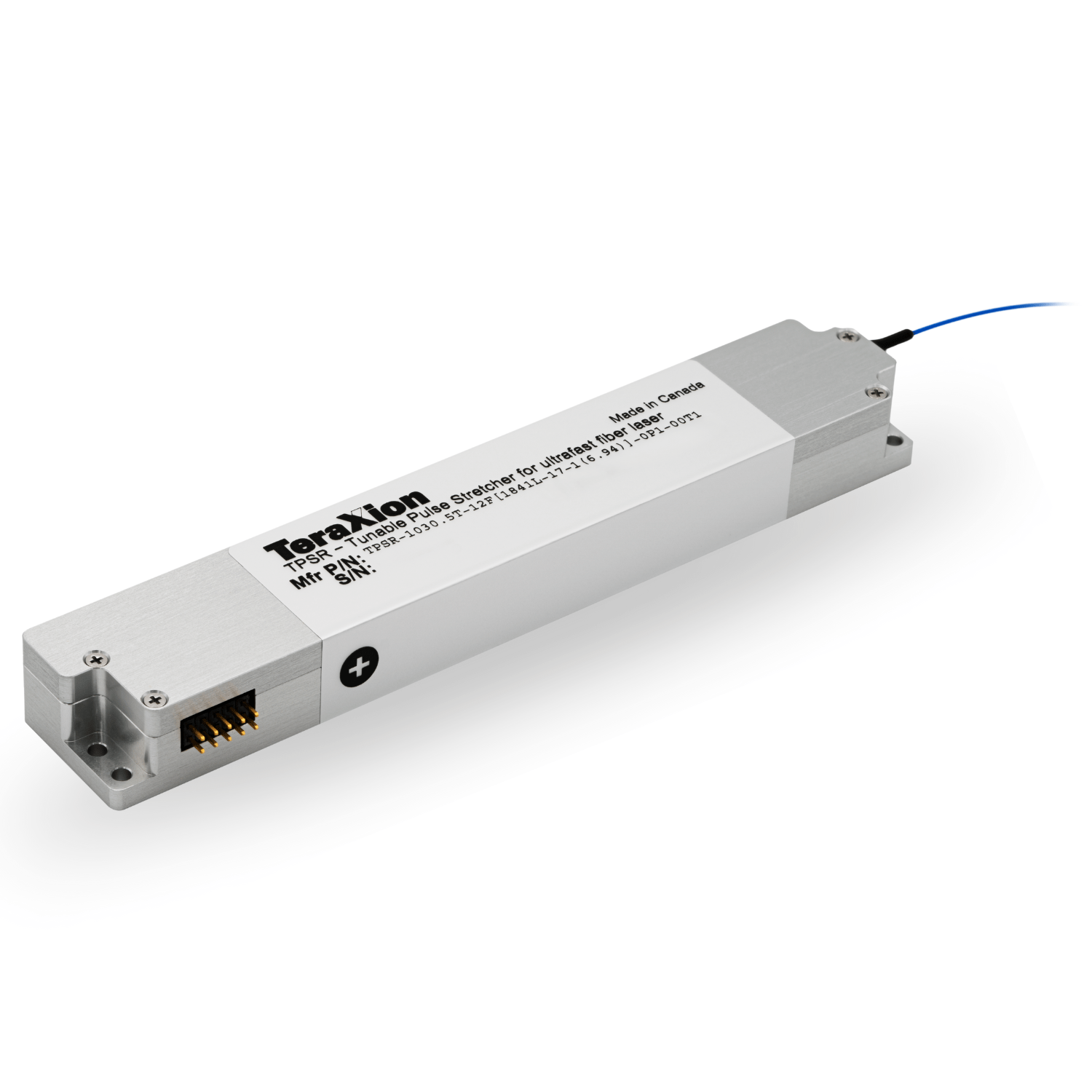
With the Ultra quality grade pulse stretcher, indie made the next generation of fiber laser possible. Now commercially available in high volumes, the TuneStretch-Ultra (TPSR-U) and FixedStretch-Ultra (UPSR) are trivial to integrate in existing systems and will enable you to stay at the front of this highly competitive environment.
Related Products
| Product | Description | |
|---|---|---|
Precision all-fiber pulse stretcher, offering tunabality over the dispersion profile without moving part. |

|
 Sales & Technical Support