





By Fred Jarrar, vice president and general manager of indie Semiconductor’s Power and ASIC Business Unit
Wireless charging is becoming an essential feature for drivers and passengers. The convenience of being able to set a device down on a charge pad without the hassle of connecting to cords or cables, plus the streamlined appeal of a decluttered and modern in-cabin environment, is contributing to the overall comfort and driving experience. This feature is proving to be more than a trend, as consumers expect on-demand access to navigation, music, and app services. In fact, the global semiconductor-enabled in-car automotive wireless charger market is estimated at $1.3 billion USD for 2022 and is forecasted to grow to $9.5 billion by 2032, representing a 22% CAGR during this period.
In its simplest form, wireless charging eliminates the cable that’s usually required to charge portable consumer devices. Rather than connecting a portable device directly to a power source via a wire, the device can charge via a wireless power transmitter. Wireless charging is not a new technology. It has been around since the late 19th century, when electricity pioneer Nikola Tesla demonstrated magnetic resonant coupling. Tesla discovered the ability to transmit electricity through the air via a magnetic field between two circuits – one a transmitter, the other a receiver.
For nearly 100 years, this technical achievement had no practical use cases – it was a solution to an as-yet-discovered societal problem. However, we’ve seen a revolution in semiconductor-enabled electronics in the past few decades, driving a need for portable, battery-powered devices in applications as diverse as consumer electronics, healthcare, and manufacturing. In the case of the automotive industry, vehicle occupants expect the use and access of their portable devices on-the-go, and so the convenience of wireless in-cabin charging represents a natural complement to wired charging. However, to ensure compatibility and consumer choice of wireless charging solutions, global standardization is key.
Launched in 2010 with oversight from the Wireless Power Consortium (WPC), the Qi (pronounced “chee”) standard focuses on mobile electronic devices such as smartphones, tablets, smartwatches, and other portable consumer devices. Currently, more than 9,000 Qi Certified products are available on the market, setting the international standard on safety, interoperability, and efficiency of wireless charging-enabled consumer devices.
Announced in early 2023, the newest generation, Qi 2.0 standard, unifies the wireless charging industry under one global standard, eliminating consumer confusion and enabling greater device interoperability. The Qi 2.0 standard also introduces the Magnetic Power Profile (MPP), a capability particularly relevant to automotive designs, offering faster, more reliable charging by automatically aligning smartphones with an inductive charging coil, maintaining the device in position irrespective of vehicle motion. Poor charging reliability had been a frequent complaint of consumers about wireless charging on-the-go, and the MPP feature of Qi 2.0 will help to address this frustrating issue.
indie develops highly integrated Qi-compliant wireless charging system-on-chips (SoCs), with a roadmap of new products evolving to support the latest generation of standards.
indie’s iND87204, a newly released wireless charging SoC, offers the highest level of system integration and is fully qualified to AEC-Q100 Grade 2, thereby simplifying and accelerating the development of cost-effective in-cabin device charging solutions. iND87204 brings an unrivaled level of semiconductor integration, simultaneously reducing the implementation footprint and external bill-of-materials by up to 50% relative to existing solutions. The device also delivers up to 15W of power and includes seamless turnkey software, helping automakers to provide a reliable and always-on in-cabin wireless experience for customers.
iND87204’s dual-core design combines an Arm® Cortex® M4F processor with 2MB of embedded Flash and 256kB of SRAM with a dedicated Arm Cortex M0 processor for the WPC stack. This approach frees SoC compute resources to execute user-specific software without timing and interrupt constraints related to the WPC stack. Additionally, indie’s wireless charging solution integrates the required power management, DC-DC converter, signal conditioning, WPC inverter drivers, and power FETs as well as LED and fan drivers. The solution also features a wide range of serial interfaces such as CAN 2.0B, LIN, I2C, SPI, and UARTs that provide multiple connectivity options to the vehicle and other peripherals.
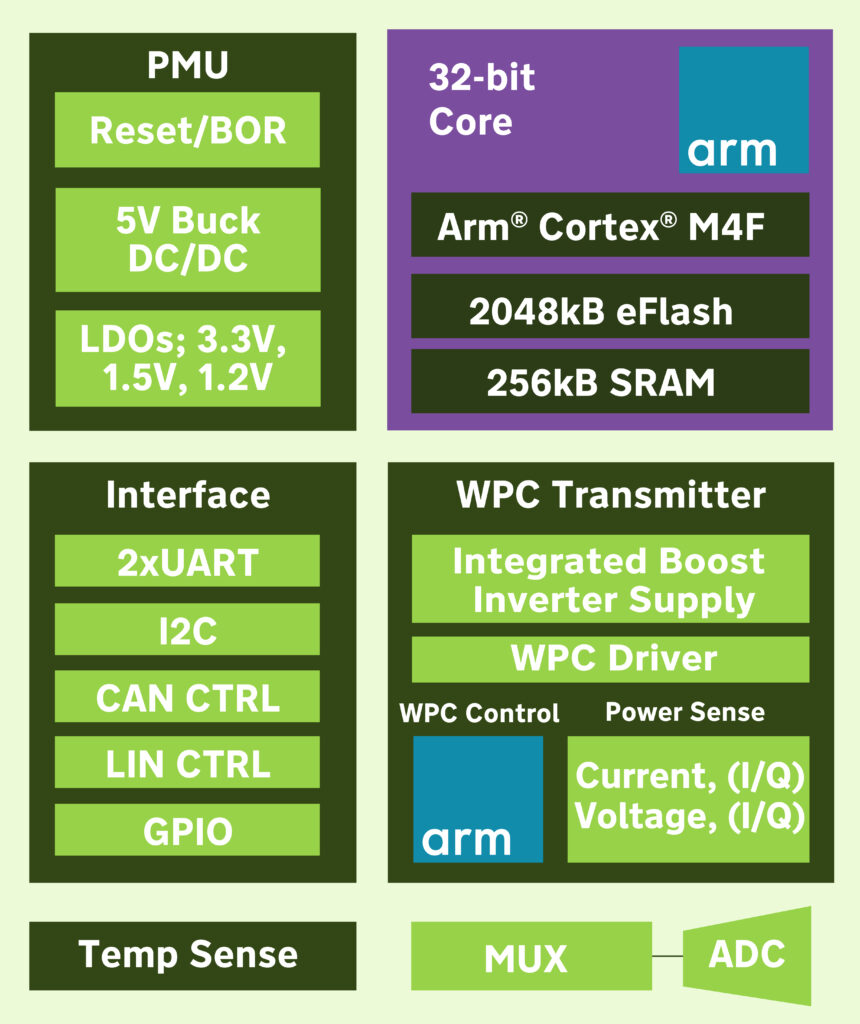
Functional diagram for iND87204, a highly integrated in-cabin wireless charging IC
It’s clear that consumers and automakers alike see the value of wireless charging. The convenience and access it provides for consumers on-the-go ensures that there is strong demand for cost-effective in-cabin wireless charging. It may be Nikola Tesla’s centuries old innovation, yet automakers are increasingly witnessing the value of wireless power for engaging in-vehicle experiences. indie will continue to support the work of the WPC and help our global partners to develop innovative solutions to offer advanced wireless charging solutions that enhance the in-cabin experience for both the driver and vehicle occupants.